Showing posts with label #historypodcasts. Show all posts

Friday, November 18, 2022

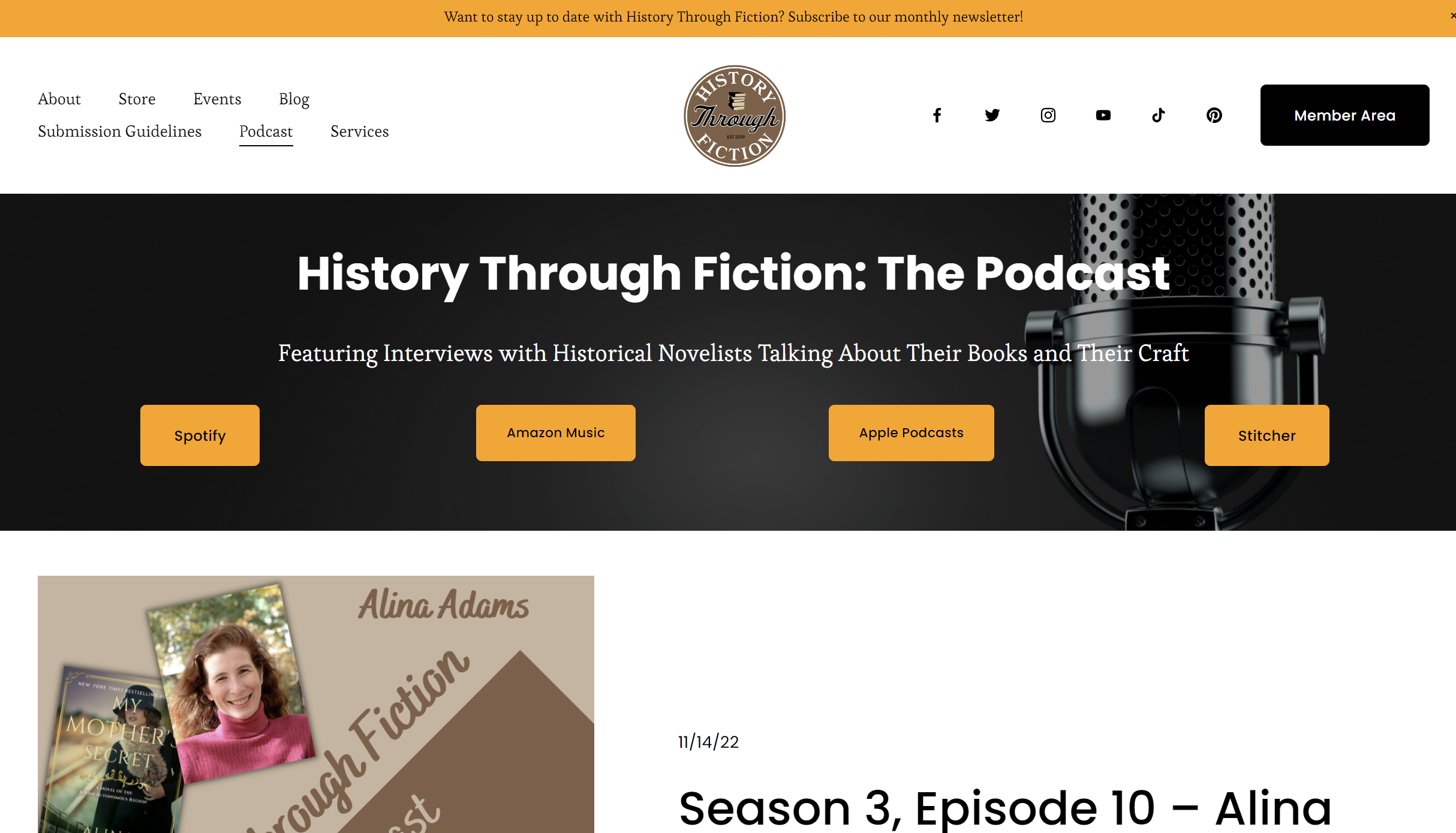
7 Questions With Colin Mustful, History Through Fiction Podcast


Colin Mustful is the founder and editor of History Through Fiction. As a traditional publisher, he works with authors who want to share important historical stories with the world. He is also an independent author and historian who has published four historical novels. He has a Master of Arts degree in history and a Master of Fine Arts degree in creative writing. Mustful is an avid runner and soccer player who lives in Minneapolis, Minnesota. He believes that learning history is vital to understanding our world today and finding just, long-lasting solutions for the future.


1. How did you get hooked on history?

My interest in history has been a process. Growing up I was always drawn by historical markers. When I reached college I began studying Native American history—especially as it related to their displacement and removal. It intrigued me that such a profound tragedy could have possibly happened and I wanted to know why. Also, during college, I discovered that I had an aptitude for writing historical essays. This led to what would eventually become a career writing and publishing historical fiction. 

2. What role does history play or has it played in your personal life?

History plays an important role in everyone's personal lives...I believe. It colors our perspective and determines our perception of the world. It helps us understand the world around us and provides us with the tools to think critically about what's going on around us and how to respond. 

3.  How does history play  a part of your professional life/career?

I work as a para educator in the social studies department at a local high school. I also write and publish historical novels. As an author and publisher, I spend a lot of time conveying history through blogs, articles, videos, and public speaking engagements. 

4. Why is studying/knowing history important?

It's absolutely vital to our understanding of the cultures, conflicts, and circumstances of the world around us. Without knowing and understanding history we cannot know or understand our neighbors or ourselves. History allows us to think critically, helping us make better, more informed decisions while giving us a deep and necessary sense of empathy for people and places outside of our own inner circle. 


5.  What is your favorite period or aspect of history to learn about and why?

I find all history fascinating in one way or another. But I'm continually drawn by the genocide of Western Indigenous peoples. It seems an impossible tragedy that we still understand so little about and have learned so little from. 

6.  How did the History Through Fiction Podcast come about?

I began podcasting with the New Book Network. This gave me an introduction to the podcasting process, something I didn't know how to do beforehand. Also, after working as a para educator in a digital music class, I learned a lot about digital audio workstations and sound design. So, after starting my press in 2019, I decided to combine my experience and knowledge to launch my own podcast as a way to advance my online presence and find more readers. 


7. What do you hope to convey to your listeners and followers?

I hope that writers can relate to the authors that are on the podcast. I hope that they discover that they are not alone in the daunting process of writing, publishing, and promoting a novel. I hope that readers gain a greater appreciation for everything a writer must go through to bring a book into the world. And, of course, I hope all listeners learn something new about history while discovering new books and authors to add to the TBR (to be read list). 


Friday, October 14, 2022

7 Questions with Sam Kean, Bestselling Author and Podcaster on Science and History


Sam Kean spent years collecting mercury from broken thermometers as a kid, and now he’s a writer in Washington, D.C. His stories have appeared in The Best American Science and Nature WritingThe New Yorker, The AtlanticSlate, and Psychology Today, among other places, and his work has been featured on NPR’s “Radiolab”, “Science Friday”, and “All Things Considered,” among other shows. The Bastard Brigade was a “Science Friday” book of the year, while Caesar’s Last Breath was the Guardian science book of the year. The Disappearing Spoon was a runner-up for the Royal Society book of the year. Both The Violinist’s Thumb and The Dueling Neurosurgeons were nominated for PEN’s literary science writing award. He also hosts the podcast "The Disappearing Spoon." where he tells stories of science and history. Website https://samkean.com/ 


1.      How and when did you get  hooked on history?

I've always liked history, but was set on being a scientist for a long time. Then I started working in real science labs, and realized it wasn't for me. (I was clumsy, and hated the specialization.) But I
thought back on what I liked about science, and realized that I enjoyed learning about the people involved - those who discovered things, those who missed out, the heroes and the villains. I liked the
stories. So learning about the history of science was a natural way to get into those stories.

2.      What role does history play or has it played in your personal life?

I think it gives me a broader perspective on the world and current events. I also enjoy seeing the cyclical nature of history - how themes and ideas repeat themselves over time. Science is a cumulative
field that builds on previous advances, but it's beholden to history
nevertheless.

3.      How does history play  a part of your professional life/career?

It's what I write about! I enjoy covering new scientific discoveries sometimes, but I feel like you don't understand what's happening unless you really get into the history.

4.      Why is studying/knowing history important?

Again, it gives your perspective. It's so easy to get wrapped up in daily events, whiplashing back and forth. Learning history teaches you to focus on what matters.


5.      What is your favorite period or aspect of history to learn about and why?


Anything science-related, I'm game to learn about. And I interpret that broadly. My new book is about experimental archaeology, and I like how the field uses science to open up whole new windows into the past.

6.       Your books and podcasts focus on the science in history or the history of science. Where did you first start to put them together?


Ha, when I realized that I was cut out to work in labs! This happened back in college, and I really wanted to keep learning about science and be involved in the field ... just not be in the lab all the time. Writing about science and science history allowed me to do that.

7.      Your most recent book is The Icepick Surgeon. After researching and writing the book, what impressions or newfound knowledge and understanding are you left with?

This was a tough book to write, but an important one for me. It takes a hard look at science and some of the awful things that have happened in the name of science. I always have and always will love science, but I don't think we can bury our heads and pretend like bad things didn't happen. But I promise my next book will be more fun. :)


Friday, September 23, 2022

7 Questions With Nick Charlie Key, Fantastic History of Food podcast


 Nick Charlie Key is a part-time history aficionado at the very tip of Africa in Cape Town, South Africa.

He explores his two great passions, food and history in a podcast aptly titled, The Fantastic History of Food, where he shares bizarre stories from history that in some way involve food.  Website: https://www.foodhistorypodcast.com/

 1.          How and when did you get  hooked on history?

I got hooked on history as a young child when my parents gave me a stunning and very big hardcover book about great historical events depicted in a where's waldo style cartoon. I would spend hours looking at, for instance, the double page spread of the pyramids and look at all of the hundreds of little people all engaged in some activity or other in ancient Egypt, floating on the Nile, getting chased by crocodiles, carrying blocks towards the pyramids build site etc. It was fascinating to me.  At the age of 10 I actually got to take a trip to Egypt and went inside one of the pyramids, went to the Cairo Museum, saw the Rosetta stone, made traditional papyrus. History came alive to me even more then.

2.          What role does history play or has it played in your personal life?

In my personal life, history is a massive part of my daily podcast intake, as I love listening to history-based shows. In other personal areas of my personal life, I grew up with a mother who was fascinated by World War 2 as her father, my grandfather, had fought in the war. We had photos of him during the war and letters he'd sent home up in frames around the house. He was a war hero for a particular conflict in Italy and was personally mentioned by the Queen of England in her dispatches for his heroism. So it's not hard to see why I too became incredibly fascinated with WW2.


3.          How does history play a part of your professional life/career?

In my professional life I studied for 4 years to be a teacher, and then taught for 5 years in a small under-resourced school in one of the townships here. I taught history, amongst a few other subjects and it was always my favourite subject to teach. My kids thrived and I like to think that I imparted my love of history into them.

4.          Why is studying/knowing history important?

This is a long and intricate question to answer properly, but at its core history teaches us about ourselves, where we came from and why we do the things we do. We're not so different from those who came before us and so we can look to history to learn how to live well today. And when it comes to human tragedy and suffering, I'm VERY sure you already know the quote, but it is very true: "Those who do not learn from history, are doomed to repeat it."

5.          What is your favorite period or aspect of history to learn about and why?

I tend to have 3 distinct periods in history that hold my attention more than others. I am enthralled with biblical era history, specifically to do with the Bible itself, but also the surrounding ages of the rise and fall of the Persian empire, Alexander the Great and of course the Roman Empire. Then I have a special place in my heart for the 1800's which seemed like an era of adventure, discovery, giant leaps forward in knowledge, inventions and general "let's try this thing and see what happens" kind of mentality. And finally as I mentioned before, I am obsessed with World War 2 for obvious, Grandfather related reasons.


6.         How did the Fantastic History of Food podcast come about?

Food and history have always been my two great passions in life. I am also a published cookbook author and worked for many years at a food based e-commerce retailer in their marketing team. I had originally conceptualised it as a content piece for the brand, but as with many things never got the time to action it. A few years later, after having moved to a different company, I thought about it again and how much fun it would be to just do in my personal capacity. The timing of it however couldn't have been worse as I, for some reason, decided to start doing it one week after the birth of my first child, hence why my release schedule is always all over the place :)

7.      What does  food history tell us about the bigger picture of history?


What I love about the history of food is that it is the one thing that ties every civilization on earth together, all throughout history. Every single one of us has had to stop to eat a meal each and every day. It's been around the dinner table that great meetings have happened, treaties and accords signed, delegations assassinated and on and on the list goes. Food has been at the centre of so many major world events. It's one of the first things to be blended when cultures collide, and food, more so than many other things defines and denotes one culture's heritage from another.


Friday, August 19, 2022

7 Questions with Chris Hasler, History of the World Podcast


Chris Hasler was born in Essex, England, where he has lived his entire life. He did not study history during his education, but he has developed a major passion for history which has led him to travel the world in search of history. He decided to write this podcast due to there being a lack of chronological material about “popular history” in the podcast marketplace, although there are many outstanding works which tell the chronological story of a particular era in history. Website https://historyoftheworldpodcast.com/


1.          How and when did you get  hooked on history?

I always had an underlying interest in history, but didn't really pursue it to any great degree until after my academic years when I started developing a desire to understand today's world and how it has come to be what it is.

2.          What role does history play or has it played in your personal life?

History plays an important part in my life now due to the intensity of the podcast, so I am now almost studying on a daily basis.

3.          How does history play  a part of your professional life/career?

It never has due to the fact that I have always worked in service sector, but with the blossoming of the podcast, I can now consider it to be a quaternary service and a contributing factor to my financial situation.

4.          Why is studying/knowing history important?

Studying history is vital for understanding the nature of things.  So whether you are a politician, a media representative or an international businessperson, having a knowledge of history will put you one step ahead.

5.          What is your favorite period or aspect of history to learn about and why?

I always gravitate towards modern European and American history possibly because I individually feel culturally close to those topics.  When it comes to English history, my interest will be excited by material stretching back to the Dark Ages, quite simply because I am an Englishman.


6.       How did the History of the World Podcast get started?

I had been listening to various podcasts such as Graham Duke and Ali Hood's Rex Factor, Lilly Cunningham's Presidential and Kevin Stroud's History of English podcasts as they took me on a chronological journey through history subjects that interest me.  I looked for a chronological history of humankind and found very little that took such a wide perspective.  I realized that I had the material and the passion to fill that void in the marketplace myself.

7.       What do you hope followers of your podcast take away with them?

Learning about history has opened my mind to the world I live in, allowing me to relate more to those who have cultural differences.  I hope that my podcast educates people to be more open minded and be prepared to listen more to their human neighbors and realize that all of our natures are actually similar because we all come from the same origin.  Of course, I should add that I hope that my listeners are simply entertained.


Friday, July 8, 2022

7 Questions with Luana Graves Sellars of the Lowcountry Gullah Podcast


A native-born New Yorker, Luana Graves Sellars, moved to Florida, and discovered that she was really "a mis-placed Floridian," and knew that snow and nor’easter’s were not meant for her. At Southern Illinois University, Carbondale, she earned a degree in Journalism with a dual minor in Business and Black History.


With her degrees, she was not prepared to live on Hilton Head Island, one of the most culturally rich and historic areas of the South. The island motivated her to become a contributing writer for local magazines with a focus on Gullah culture, its history, people and native island issues by researching, documenting and publishing cultural legacies in an effort towards preservation. In 2021, she expanded  into visual media, by writing and producing cultural videos and documentaries. As the owner of Sankofa Communications, founder of the nonprofit(s) Lowcountry Gullah and the Lowcountry Gullah Foundation, a keynote speaker, writer, filmmaker, community activist and cultural influencer, she is sustaining and preserving Gullah culture for future generations.


1. How and when did you get  hooked on history?

History has always fascinated me and was one of my favorite classes since elementary school. In addition to American History, learning about Black History has always been important to my family, which eventually led to getting a degree in Black History.

2. What role does history play or has it played in your personal life?

Today, history has become a constant focus for me everyday, both professionally and personally. The work that I do documenting and preserving Gullah cultural traditions includes the history and in some cases genealogical research, which also lends itself to getting a chance to peek behind the curtain of someone’s past. As a result, my search into my own family lineage has merged into my work and my work has become a personal as well as cultural experience that offers motivation and inspiration for myself and my followers.

3. How does history play  a part of your professional life/career?

In order for me to document the Gullah culture, which is rooted in African traditions, it needs to begin with the history of the Trans Atlantic Slave Trade, which in turn blends the history and cultures of not only US history, but the history of several African countries. Lowcountry Gullah sole purpose is for future generations as it honors the past.


4. Why is studying/knowing history important?

The African proverb of the Sankofa says it best. Symbolized as a bird looking backwards towards an egg, it literally translates to San - go back or return, Ko - to go, Fa - to fetch. In other words, learning from the past is how to improve the future.

5. What is your favorite period or aspect of history to learn about and why?

I would say, that the colonial period and specifically, Black History have always been my favorites. It has become really unexpected and coincidental that my work has become targeted towards the 400 years during slavery.


6.        How did the Lowcountry Gullah podcast come about and what’s a typical episode about? 

The Lowcountry Gullah Podcast is an extension of my writing as a Cultural Influencer. The website www.lowcountrygullah.com offers several options for people to receive and enjoy cultural information through articles, documentaries and video snippets on YouTube and now through the podcast. All of the podcast topics are focused on the Gullah culture, history and traditions as well as the current issues that effect it. Sharing the culture includes stories and interviews with interesting people who I call the Keepers of the Culture.

7.       What do you hope listeners take away from your podcast?

My hope is that people listen to the podcast and are able to grow into and learn about the culture. Unfortunately, as a consequence of slavery, most Black/African Americans don’t have a cultural identity or foundation. Daily, I encounter people who are unaware that they too are Gullah Geechee and are not familiar with their roots or all of the richly significant cultural contributions that are woven into American society. Lowcountry Gullah’s ultimate goal is to educate, inform and culturally ground current and future generations.


Friday, March 18, 2022

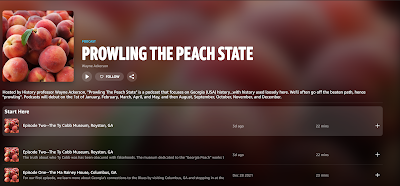
7 Questions with Wayne Ackerson, Prowling the Peach State


Wayne Ackerson was born in Corpus Christi, Texas but grew up around the world with a father who was in the navy.  He's been a college professor since 1990, teaching in Maryland and Georgia. In his spare time, he's a photographer, a minister, and enjoys reading, eating out, working out, and movies.  He earned his Ph. D. in British History from Temple University in 1999.

1.         How and when did you get  hooked on history?

Well, I was born in Texas but grew up in England, and I think living there is what did it.  You couldn’t go anywhere or do anything without being surrounded by history.  World War Two was still a big part of their cultural life, and it seemed like every TV show was about World War Two in some fashion (this was the early 70s).  I would just say that I have always loved history, for as long as I can remember.

2.         What role does history play or has it played in your personal life?

When I started college, I was a Psych major, but ended up with a double major with Psych and History.  Then onto an MA and started teaching college, then got my Ph.D. in History.  I’ve been a history professor since I was 24, back in 1990. 


3.         How does history play  a part of your professional life/career?

To say it’s important is an understatement.  It’s what I do, every day as a history professor at Georgia Gwinnett College in Lawrenceville, GA.

4.         Why is studying/knowing history important?

I am a big supporter of a broad-based, liberal arts type of education.  I believe that as citizens we should be generally well-rounded and well-informed.  In some ways, this is knowledge for knowledge’s sake.  I also believe that trends repeat themselves, and so it is useful to us to know what those are.  And of course there are practical skills which come from the study of history, such as understanding cause and effect, change over time, and being able to think critically about sources and information.

5.         What is your favorite period or aspect of history to learn about and why?

There isn’t much I dislike.  My specialty is 19th century Britain, British anti-slavery in particular.  I wrote a book called  The African Institution (1807-1827) and the Anti-slavery Movement in Great Britain which came out in 2005.  I love the Tudor-Stuart period, and ancient Greece and Rome.  I love south Asian history, which is mainly what I teach.  I enjoy anything to do with aviation (my dad was a Navy pilot).  There’s just so much to like in all these areas!


6.         What is Prowling the Peach State and how did it come about?

Prowling The Peach State is a podcast that deals with Georgia history, very broadly defined, with an emphasis on things off the beaten path.  It just seemed like a fun idea to try and do.  I don’t for a minute think I am discovering “new” things, but maybe some of the locations are ones that many people don’t know much about.  I try to put the topic or location in a broader context as much as possible, be entertaining, and also be interesting and informative.  Georgia is a state with all kinds of stuff in it, and through the series I hope to teach Georgians a few things about their relative backyards, and I’d also hope to encourage out-of-staters to visit.

I also have a companion Facebook page where I post photos I’ve taken on location, random stuff to do with that month’s topic, as well as lesson plans (questions, really) for teachers who might want to use the podcasts with their students.

7.         What can lovers of history expect in the future from Prowling the Peach State?

Well that’s a secret!  What I can say is I have a long list of topics/places I want to cover.  Most will be serious, but there’s a few bizarre ones in there too.


Friday, February 4, 2022

7 Questions with Jennifer Bennie, "Walk With History" on YouTube and "Talk With History" Podcast


Jennifer Bennie, of the YouTube Channel “Walk with History” also the podcast “Talk with History,” is a former Naval Aviator turned historian.  After earning a Masters of American History from the University of Memphis with the GI Bill, her research resulted in the dedication of a historic marker in downtown Memphis memorializing the first documented lynching to occur in Memphis on January 1st 1851.  She currently is a museum attendant at the MacArthur Memorial in Norfolk, Virginia.  New episodes of “Walk with History” and “Talk with History” are published every week. 


1.          How and when did you get hooked on history? 


I was very interested in history when I got my undergrad 20+ years ago at Penn State University, so much so that I got a minor in History.  However, I really got “hooked” on history when I went into the US Navy right after graduation.  I wanted to learn more about the history of the Navy, which led to opening more doors to learn about American History, especially as I traveled overseas. I really wanted to understand more about the dynamics I found myself in with present politics and how the past impacted that.  I was lucky that I was able to use my GI Bill and pursue a Master’s Degree in American History, that has only allowed for more in-depth learning and understanding of history.   


2.          What role does history play or has it played in your personal life?


History is part of my personal life as filming for the “Walk with History” YouTube channel is done, for the most part, with my family, and we make it a family day when we film.  My husband does some of the filming, all the editing, and my kids love to hear the stories.  We usually make an adventure of it, go on a road trip, bring lunch, and all learn about something historic as we film for the channel.  The kids have loved going to Colonial Williamsburg, Arlington National Cemetery, and Jimmy Stewart’s hometown of Indiana Pennsylvania to just name a few.   


3.          How does history play a part of your professional life/career? 


For my professional career, I work as Museum Attendant at the historic location where General MacArthur is entombed as well as it is a museum dedicated to his story.  The MacArthur Memorial is located in the old city hall building of Norfolk, Virginia and there are nine galleries that house the artifacts of his life.  From his parents, West Point, WWI, WWII, Korea and after, the memorial does a great job of trying to explain who this complex military leader was as well as his impact on history.   


4.          Why is studying/knowing history important? 


I believe studying history is important to understand where we find ourselves in the present.  I also believe you must start from a place of truth to really know where you are and where you are going.  That was one of the reasons for “Walk with History” to build public trust with the truth of what really happened in historic locations while taking the viewer to see that real life location.   


5.          What is your favorite period or aspect of history to learn about and why?  


I pursued a Masters in American History because I love to learn about the past events that happened in America.  I like to take my YouTube viewers to the locations where the giants of history walked before us.  My favorite though would have to be colonial times, mostly because America was so new.  I like to learn how the foundations of the country were made, why and by who.  It really interests me to see all the moving parts with how direct and indirect power were taking hold of a young nation.   


6.        How did Walk With History get started? 


“Walk with History” was started when I took a break from social media.  There was so much untruth online, and I wanted to get the “noise” out of my head.  I had more free time which led to wondering if people had gone to different historic locations and what they looked like today.  I got on YouTube, looking things up I wanted to see, etc. and noticed that either no one had filmed a video at that location, or if a person had filmed a video, they did not do a good job of relaying the history for the viewer.  So I approached the topic with my husband, Scott, since he had been doing a family YouTube channel for a couple of years.  He thought it was a great idea, we started collaborating and we have been doing it ever since.  It will be a year in April 2022.  We have committed to being consistent and have done one episode a week.  We do all types of historic topics, movies, true crime, cemeteries, Civil Rights, Presidents, etc.  Anything that I would be interested to watch is usually what we film.   


7.      What’s been your favorite site visit so far? What’s something on your bucket list of sites? 


So far, my favorite site to visit has been Maureen O’Hara’s grave at Arlington National Cemetery, it was such an honor to be there.  I was such a fan of her movies.  I also was really excited to stand on Jimmy Stewart’s porch of his family home.  You can see me kind of freak out our YouTube video from his hometown.  “It’s a Wonderful Life” is my favorite movie of all time.  I really enjoyed taking my kids to “Washington Crossing” and “Yorktown” to talk about the battles that took place to change the tides of the American Revolution.  I did a 3-part series on Emmett Till, and that was very hard emotionally to film but I felt it was so important to share.  I had done a lot of research in that case, and I wanted my viewers to see exactly where those horrible events took place, but mostly to remember he is never forgotten.  The one place I cannot wait to visit is Monument Valley in Utah.  I want to recreate some scenes of my favorite western “The Searchers” and just to be in that area to give some attention to the lives of American Indians.  I also cannot wait to take my family to “The Battle of Little Big Horn” to show them that location and what happened there with Custer’s last stand.