Showing posts with label #chattingwithtehistocrats. Show all posts

Friday, January 6, 2023

7 Questions With Cody C. Engdahl, Author of Historical Fiction


Cody C. Engdahl was born and raised in Detroit but lives in Nashville, Tennessee. He's a practitioner of the "Southern Gentlemanly Arts." In addition to writing a series of historical novels focusing mostly on the Civil War, he is also an amateur fiddler, cook, whiskey connoisseur, and armchair historian.  


                                                                                                                                                                                                           1.   How and when did you get hooked on history?

I’ve been into history for as long as I can remember. I think it must have started when I was a child watching old swashbuckling movies. I remember making swords out of sticks and pretending I was a knight, a Roman legionnaire, or Errol Flynn on a pirate ship. I remember thinking that I had been born too late as I fantasized about the time when men wore swords on their hips and had dashing adventures.


2. What role does history play or has it played in your personal life?


It’s the source of all my entertainment and passion. I feel sorry for my girlfriend because I never want to watch anything unless it has swords or possibly spaceships. All the novels I read are historical fiction. I can spend hours online looking at the succession of English kings or reading about some ancient battle for no other reason than satisfying my own fascination.


3. How does history play a part of your professional life/career?


It’s at the core now of my professional life. I started writing historical novels after I left my career as a TV reporter. Researching, writing, editing, and marketing take up much of my time. I also do as many book talks and signing as I can. I play old-time fiddle, which works nicely with the era in which I write. My banjo player and I play a lot of gigs at historical events and sites, often in period clothing. I typically play my fiddle at Civil War shows as well to attract people to my table. It helps me sell books!


4. Why is studying/knowing history important?


History is the story of who we are and how we got here. It’s difficult to solve the problems of today and tomorrow if we don’t understand those two things. You can also see repeating patterns in history and human behavior. The study of history is really the best way of predicting the future.


5. What is your favorite period or aspect of history to learn about and why?


That’s the toughest question yet. I like it all! My writing focuses on the “Long 19th Century,” which is roughly the French Revolution to the onset of World War I. It’s the story of modernity. Most of our worldview is born from this age. It’s a time of great turmoil and transition. It’s both familiar and exotic to us. 

I’m also very much a twelve-year-old boy at heart so I tend to obsess over military, weapons, war, adventure, and honor culture. But that’s just because I’m immature and not for any profound reason.


6. What drew you to writing historical fiction in general and about the Civil War in particular? 


Because I’m a fan. Like many historical novelists, I am a big fan of Bernard Cornwell as well as too many others to name, but I must say it was Arturo Perez-Reverte’s Alatriste series that finally prompted me to write. I felt the American Civil War was the best place to start because I was familiar with it, there's a ton of resources, and a huge built-in audience. I practically live on a battlefield. 


7. Please tell us about Mexico, My Love, your latest novel?


That’s a prequel to my Civil War trilogy that I had planned from the very beginning. You can see me setting it up in Chapter One of my first novel, Rampage on the River: The Battle for Island No. 10. It’s the story of the parents of my main character in the trilogy. It’s about how they meet, fall in love, run away together, and go on a grand adventure that’ll take them through the deserts of Africa, across the pirate-infested seas, and ultimately to the Battle of Mexico City in the Mexican-American War. 


Friday, September 2, 2022

7 Questions with Dave Wilson, Victorian Photography Studio


Dave Wilson is a Wetplate Collodion photographer residing in Geneva NY. A long time student of history, he owns and operates the Victorian Photography Studio in Gettysburg PA, and takes his tintype camera on the road all over the United States. When he’s not on traveling shooting images, he takes care of a small Victorian era farm and drives the Zamboni at the local ice rink. www.victorianphotostudio.com


 1. How and when did you get hooked on history?

 In 1st grade, growing up in Illinois, we took a field trip to the Rock Island Arsenal, which has a confederate cemetery. I had misheard them, thinking they were calling it the "Silver War," but they had a bronze cannon, and my 1st grade brain couldn't rationalize that, so I bought my first civil war book in the gift shop and I was hooked.

2. What role does history play or has it played in your personal life?

History is omnipresent in my life. Besides being an amateur historian and full time practitioner of a 19th century trade, my wife is a National Park Service superintendent at  Women's Rights National Park, and we are restoring an 1850's farm

3. How does history play a part of your professional life/career?

*see above

4. Why is studying/knowing history important?

Understanding the lives/feelings/beliefs of people in the past gives us context to the decisions they made, and how those decisions and attitudes have shaped our country and the direction of the world in general


5. What is your favorite period or aspect of history to learn about and why?

the mid 19th century in general. The American Civil War has always been my favorite, but I love just about anything in the Victorian period. I also really like the Napoleonic era, especially seafaring history.

6. What attracted you to Civil War and Victorian era photography?

I had been a reenactor and always loved having images made. When an opportunity came up to learn, I jumped on it and have been working at it ever since.


7. What do you provide for your customers in their experience? Who are your customers?

My customers vary! In the studio, 99% of our clients are tourists who are visiting and want to dress up. When I'm on the road, I shoot mainly people in modern clothes, and my clientele is widely varied. I spend a lot of time shooting at tattoo studios, horse barns, metalsmith shops, and barbershops. Its a lot of fun introducing this era of photography to people who are not familiar with it.


Friday, February 18, 2022

7 Questions With Laura Rocklyn, Writer, Actress, and Historical Interpreter


Laura Rocklyn is an acting troupe member with History At Play, a museum interpreter at The Paul Revere House Museum, and an Associate Company Member at The Chesapeake Shakespeare Company. As a freelance living history performer, she writes and performs historic character portrayals for educational groups up and down the East Coast, such as the Jane Austen Society of North America, The New York Society Library, and the North American Friends of Chawton House. Laura has published articles in Brontë Studies and The Revere Express, and her short stories have appeared in the literary journals Stork, New Square, and LitMag. You can follow her work on Instagram and Twitter @Laura_Lost_in_Time


1.          How and when did you get  hooked on history?

My love of history started early.  My mother was a teacher and, in addition to exploring the rich history of our hometown Charlottesville, Virginia, she planned all of our vacations when I was growing up around history and literature.  This made the historical stories and characters I was studying feel very real and near to me, not like tales of a far off or unimportant time.  I remember the particular magic of a trip to England when I was around seven or eight and deep into an obsession with the musical Camelot, where we went in search of the historical King Arthur.  We visited sites with Arthurian connections, from Tintagel Castle to Stonehenge to Glastonbury Abbey.  My mother guided me on how to separate fact from legend as we read and researched different accounts of King Arthur along the way.
Then, when I was in sixth grade, my mother got a job teaching in Salisbury, England, and I went with her and attended the Salisbury Cathedral School.  The school had been founded in 1091 by St. Osmund, and is housed in the old Bishops' Palace, parts of which date back to the 13th century. Being immersed in that depth of history on a daily basis fascinated me, and I loved living in a place where tangible evidence of historical events was all around.  There is nothing quite like walking every day up a stone staircase where each step is worn down in the center from all the people that have walked the staircase before you over the last 800-odd years.

2.          What role does history play or has it played in your personal life?

History is very much a part of my daily life.  Since my childhood experiences, I have always been drawn to live in places that have a strong sense of history, from Old Town Alexandria, Virginia to Boston, Massachusetts.  As an actor, writer, and first person historical interpreter, I find that historical stories are my greatest inspiration -- there are so many good ones that have yet to be uncovered -- and I love to be in a place where I can stumble across new stories and historical figures around every corner.
My work on Marian "Clover" Adams actively changed my life because she is the reason that I now live in Boston.  When the play that Ty Hallmark and I wrote about Clover was produced by Ally Theatre Company in Washington, DC in 2017, Clover's biographer, Dr. Natalie Dykstra, very graciously came to see a performance and join us for a Q&A.  When we were talking after the show, I told her how much I admired her work and asked what she would recommend for an aspiring young biographer.  Without hesitation, she said that I should go to Emerson College in Boston and study with a specific professor there who had also been an extraordinary mentor to her.  I was in the midst of applying to graduate schools for Creative Writing MFAs and added Emerson to the list.  I was accepted, fell in love with Boston and all of the extraordinary stories that are held in its stones.  The rest, as they say, is history!

3.          How does history play  a part of your professional life/career?

History has come to be the main focus of all of my work.  Growing up, I always knew that I loved telling stories, both writing them and bringing them to life on stage as an actor, and most of the stories that truly captivated me were about historical women.  Like many young girls of my generation, my two best friends and I had the American Girl dolls, and our first plays as very young children were about the adventures of Kirsten in 1854, Samantha in 1904, or Felicity in 1774.  I didn't know quite how I could make writing and performing historical dramas into a practical job when I was an adult in the real world, but I felt something like a vocation to inspire others to be fascinated by history in the way that I had been inspired.  Then, in the summer after my junior year of college, I had the extraordinary opportunity to do an internship at Colonial Williamsburg in what at that time was called the Theatrical Interpretation Department.  Performing four educational shows a day at the Playbooth Stage, I discovered that writing and performing historical stories was a real job that I could do very well!
My main focus for many years was working as a freelance actress, performing mostly in Shakespeare and other period dramas, but my "day jobs" always had a historical focus, too.  I worked as a first person historical interpreter for Mount Vernon, I portrayed various characters for Natalie Zanin's Historic Strolls, I gave tours at Gadsby's Tavern Museum, and, increasingly, I began to develop programs of my own on historical women who intrigued me.  Now, a couple of master's degrees later, I tour with portrayals of Jane Austen, Dolley Madison, Louisa Catherine Adams, Clover Adams, and Charlotte Brontë, and I have a long list of new programs that I want to develop.  I have also published a number of historical fiction short stories, some nonfiction articles on my research, and I am currently working to finish the historical fiction novel I began as my MFA thesis at Emerson.  I also perform in several of the ensemble programs offered by History At Play and, by day, I work as a museum interpreter at the Paul Revere House Museum.


4.          Why is studying/knowing history important?

I have always admired the mission statement that John D. Rockefeller Jr. gave on the founding of Colonial Williamsburg: "That the future may learn from the past."  I don't think it's possible to overstate the importance of trying to understand and learn from the past as we move forward, especially in such turbulent times as these.  History can give us extraordinary examples that we can follow, and by which we can be inspired.  Just as importantly, history can also give excellent examples of what not to do and what should be avoided.
The laudable National History Day program highlights another reason that the study of history is so vital: teaching children how to read primary sources thoughtfully and critically in the study of history can enable them to apply those same critical skills in reading current articles and news stories.  If students learn to question, "Who wrote this historical document?" " What were their biases?"  "Were they writing this piece for a specific audience?"  then those students will know how to ask similar questions about the current news articles and other pieces of information that pop up in their social media feeds.
History can also be a great source of encouragement and even comfort.  I navigated the early months of the pandemic in 2020 by reading about the series of smallpox epidemics that swept through Boston in the 18th century and about the 1918 flu epidemic.  There was reassurance to be found in the fact that humanity has been through similarly terrifying times before and come out on the other side.

5.          What is your favorite period or aspect of history to learn about and why?

My first serious historical love was 19th century England because I spent most of my teenage years obsessed with the novels of the Brontë sisters, Elizabeth Gaskell, George Eliot, Charles Dickens, and Anthony Trollope.  I wrote numerous papers in high school with titles along the lines of:  "Charlotte Brontë's Shirley and Dickens' Hard Times as Windows into Life During the Industrial Revolution," and my undergraduate thesis was on spirituality in Charlotte Brontë's novels and the politics of religion in Victorian England.
As an adult, I've found that the historical period on which I focus at any given time is strongly influenced by where I'm living.  When I was based just outside of Washington, DC, I was completely absorbed by the Federal Era.  Reading Catherine Allgor's book Parlor Politics as a young woman in DC was a revelation to me because it introduced me to all of these fascinating, powerhouse women -- Louisa Catherine Adams, Dolley Madisosn, Elizabeth Patterson Bonaparte -- who made incredible contributions to the development of our young country, but are all too often overlooked by the history books.  My first ever visit to do research in an archive was to the Maryland Historical Society to look at Betsy Bonaparte's papers, and I was blown away by the sweeping view of American and European politics that came through in the letters, invitations, and scrapbooks of this woman from Baltimore.
Now that I am in Boston I am still fascinated by the incredible women shaping society here in the Federal Era -- a lot of my work these days is swirling around Hepzibah Swan and Sarah Wentworth Morton -- but I am also looking closely at the experiences of women during the American Revolution that formed these creative women of the Federal Era.  I love that, in all of these time periods that one might think we study in such detail in school, there are so many stories -- especially about women and people of color -- that have been overlooked and still need to be brought into the light.
I guess, looking over what I've written, the short answer would be that I tend to focus on women's history in the United States and Britain between about 1770 and 1870.

6.        How do you select the characters you portray? Is there a common theme among the characters you portray?

The characters I choose to portray are all women whose stories inspire me, and to whom I have felt a strong personal connection.  When I was younger and just starting out as a living history performer, my first two portrayals were my two favorite authors, Jane Austen and Charlotte Brontë.  I still think there is a value in portraying those two well-known women because fans of their novels are drawn to the programs.  Then, in talking about the broader lives of these authors, I can share stories about their involvement in historical events with which they aren't often associated, such as the experiences of Jane Austen's naval brothers during the Napoleonic Wars, or Charlotte Brontë's experiences in Brussels.
Now that I have more experience and more years of research under my belt, I like to find women whose stories and work deserve a wider audience.  This is why I portray Louisa Catherine Adams and Clover Adams.  Abigail Smith Adams is such a towering figure in history that the remarkable women who married into the Adams family in the subsequent generations are often overshadowed.  One thing I particularly enjoy is that, when I mention my program on Louisa, I generally get one of two responses: people are either curious because they've never heard of her, or they get really excited because they adore her.  There is rarely a middle ground.  I am so glad that I can now be the means of showing more people why they should, not only know who Louisa is, but adore her, too.  Because Louisa did such an exquisite job of documenting her experiences all over Europe while her husband, John Quincy Adams, held various diplomatic posts, that program is also an exciting way to explore a wide view of culture and politics from Massachusetts to Russia in the late 18th/early 19th century.


7.      What do you do in order to prepare for your portrayal in terms of research and creation?

Once I've pinpointed a woman I want to portray, I always read as many different biographies of the person as are available so that I can get a good overview of the figure's life and world.  Then, the most important part of my process is going back and immersing myself in the historical figure's own writings and papers, so I can draw my own conclusions and form my own picture of them from their own words.  I want to portray the person, not the legend.  (In a couple of cases, for programs I'm working on now, going to the person's papers in the archives has had to be the first step because there isn't yet a biography.)  I like to get as close to the person and their thoughts as possible -- I have spent many wonderful hours with Louisa Adams' papers on microfilm at the Massachusetts Historical Society -- but, if possible, I also always get the published collections of their papers to have in my study so I can refer to them at any time as I'm writing, like Margaret Smith's extraordinary three volume Letters of Charlotte Brontë.
To ensure that every aspect of my portrayal is as accurate as possible, I like to visit any places connected with the figures, see any of their possessions that still exist in museums, look at portraits, read any books that they mention reading in their papers, listen to the composers I know they admired, look at paintings they mention having seen.  I do my best to immerse myself in the historical figure's life and world as much as possible.  From this research, I like to add little details in my dress and setting as little treats in each program that scholars or real fans of the character will notice, even if I never refer to them in the performance.  For example, my Jane Austen always wears a replica of the topaz cross that was given to her by her brother Charles, and the dress I commissioned for my Charlotte is based on her "Thackery dress" in the collection of the Brontë Parsonage Museum.
I have a playlist for each of the characters I portray of music they mention in their letters, other music of the era, and any songs that remind me of them.  I listen to that collection of music before each performance, and that helps me be taken back to that headspace and into their world.
To start writing, I choose a dramatic moment in the life of the person so that something active is calling them to look back over their life.  I want the humanity of the character to come through in my portrayals, in addition to the facts of their life.  I think it's important to convey that these were living, breathing, fallible, caring, inspiring real people.  In my programs, I want history to come off the page and into people's lives.


Friday, February 4, 2022

7 Questions with Jennifer Bennie, "Walk With History" on YouTube and "Talk With History" Podcast


Jennifer Bennie, of the YouTube Channel “Walk with History” also the podcast “Talk with History,” is a former Naval Aviator turned historian.  After earning a Masters of American History from the University of Memphis with the GI Bill, her research resulted in the dedication of a historic marker in downtown Memphis memorializing the first documented lynching to occur in Memphis on January 1st 1851.  She currently is a museum attendant at the MacArthur Memorial in Norfolk, Virginia.  New episodes of “Walk with History” and “Talk with History” are published every week. 


1.          How and when did you get hooked on history? 


I was very interested in history when I got my undergrad 20+ years ago at Penn State University, so much so that I got a minor in History.  However, I really got “hooked” on history when I went into the US Navy right after graduation.  I wanted to learn more about the history of the Navy, which led to opening more doors to learn about American History, especially as I traveled overseas. I really wanted to understand more about the dynamics I found myself in with present politics and how the past impacted that.  I was lucky that I was able to use my GI Bill and pursue a Master’s Degree in American History, that has only allowed for more in-depth learning and understanding of history.   


2.          What role does history play or has it played in your personal life?


History is part of my personal life as filming for the “Walk with History” YouTube channel is done, for the most part, with my family, and we make it a family day when we film.  My husband does some of the filming, all the editing, and my kids love to hear the stories.  We usually make an adventure of it, go on a road trip, bring lunch, and all learn about something historic as we film for the channel.  The kids have loved going to Colonial Williamsburg, Arlington National Cemetery, and Jimmy Stewart’s hometown of Indiana Pennsylvania to just name a few.   


3.          How does history play a part of your professional life/career? 


For my professional career, I work as Museum Attendant at the historic location where General MacArthur is entombed as well as it is a museum dedicated to his story.  The MacArthur Memorial is located in the old city hall building of Norfolk, Virginia and there are nine galleries that house the artifacts of his life.  From his parents, West Point, WWI, WWII, Korea and after, the memorial does a great job of trying to explain who this complex military leader was as well as his impact on history.   


4.          Why is studying/knowing history important? 


I believe studying history is important to understand where we find ourselves in the present.  I also believe you must start from a place of truth to really know where you are and where you are going.  That was one of the reasons for “Walk with History” to build public trust with the truth of what really happened in historic locations while taking the viewer to see that real life location.   


5.          What is your favorite period or aspect of history to learn about and why?  


I pursued a Masters in American History because I love to learn about the past events that happened in America.  I like to take my YouTube viewers to the locations where the giants of history walked before us.  My favorite though would have to be colonial times, mostly because America was so new.  I like to learn how the foundations of the country were made, why and by who.  It really interests me to see all the moving parts with how direct and indirect power were taking hold of a young nation.   


6.        How did Walk With History get started? 


“Walk with History” was started when I took a break from social media.  There was so much untruth online, and I wanted to get the “noise” out of my head.  I had more free time which led to wondering if people had gone to different historic locations and what they looked like today.  I got on YouTube, looking things up I wanted to see, etc. and noticed that either no one had filmed a video at that location, or if a person had filmed a video, they did not do a good job of relaying the history for the viewer.  So I approached the topic with my husband, Scott, since he had been doing a family YouTube channel for a couple of years.  He thought it was a great idea, we started collaborating and we have been doing it ever since.  It will be a year in April 2022.  We have committed to being consistent and have done one episode a week.  We do all types of historic topics, movies, true crime, cemeteries, Civil Rights, Presidents, etc.  Anything that I would be interested to watch is usually what we film.   


7.      What’s been your favorite site visit so far? What’s something on your bucket list of sites? 


So far, my favorite site to visit has been Maureen O’Hara’s grave at Arlington National Cemetery, it was such an honor to be there.  I was such a fan of her movies.  I also was really excited to stand on Jimmy Stewart’s porch of his family home.  You can see me kind of freak out our YouTube video from his hometown.  “It’s a Wonderful Life” is my favorite movie of all time.  I really enjoyed taking my kids to “Washington Crossing” and “Yorktown” to talk about the battles that took place to change the tides of the American Revolution.  I did a 3-part series on Emmett Till, and that was very hard emotionally to film but I felt it was so important to share.  I had done a lot of research in that case, and I wanted my viewers to see exactly where those horrible events took place, but mostly to remember he is never forgotten.  The one place I cannot wait to visit is Monument Valley in Utah.  I want to recreate some scenes of my favorite western “The Searchers” and just to be in that area to give some attention to the lives of American Indians.  I also cannot wait to take my family to “The Battle of Little Big Horn” to show them that location and what happened there with Custer’s last stand.   


Friday, January 14, 2022

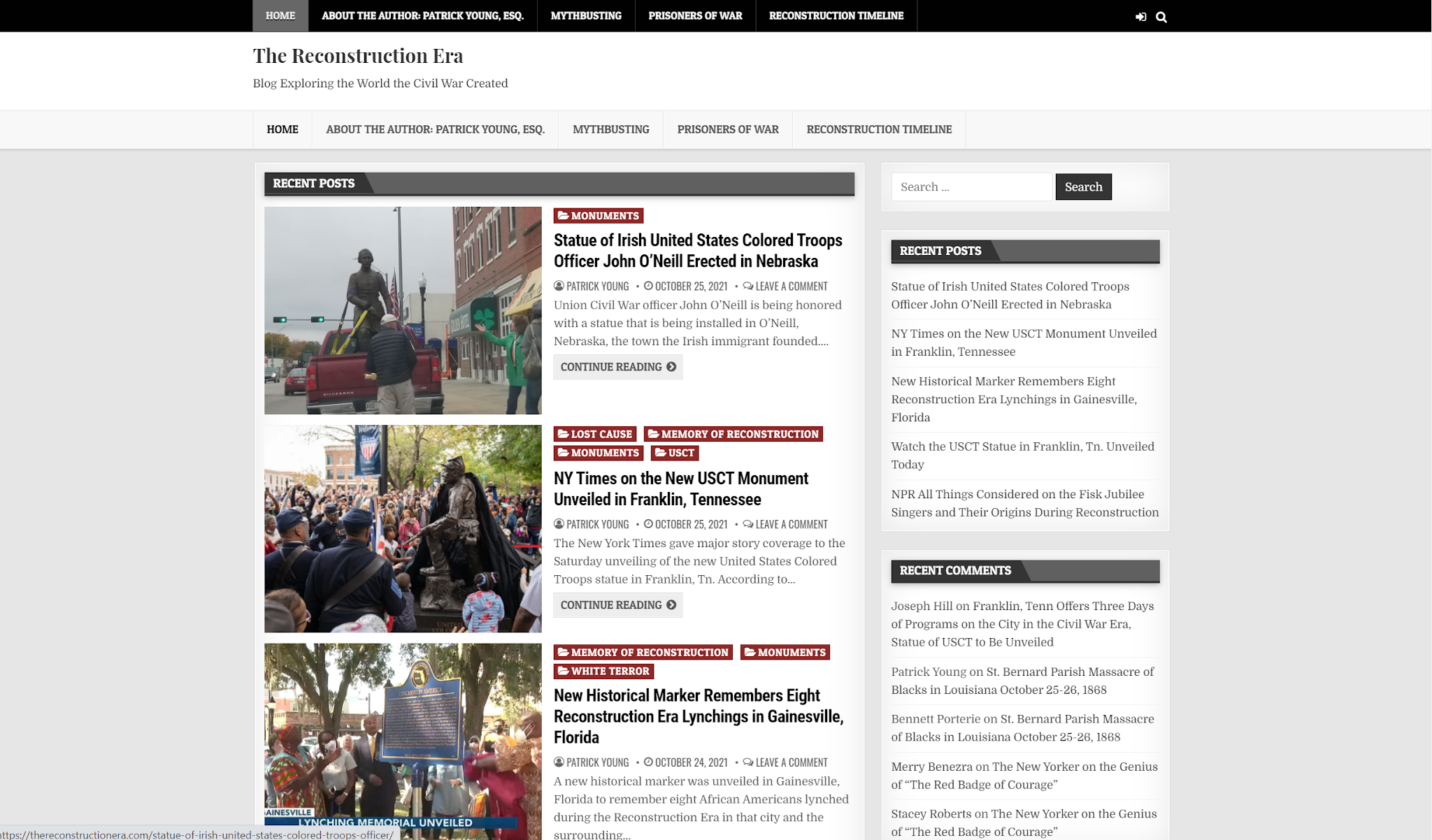
7 Questions With Pat Young, The Reconstruction Era Blog


Pat Young writes The Reconstruction Era Blog and The Immigrants' Civil War. He is Special Professor of Immigration Law at Hofstra Law School in New York and he works to provide services and advocacy for immigrants in New York City, Long Island and the Hudson Valley. ( Reconstruction Era  https://thereconstructionera.com/ , Immigrants' Civil War https://longislandwins.com/immigrants-civil-war/ )


1. How and when did you get  hooked on history?


Like a lot of older white men, I date my interest back to the Civil War Centennial (1961-1965). Since I was only three when the Centennial started, I must have caught the tail end of it. Over time my interest in history matured and I studied the histories of a number of civil wars, and looked at their aftermaths. I was in-country doing human rights research during one civil war, and my wife’s uncle fought in another, the Spanish Civil War, in the “Abraham Lincoln Brigade.” I have interviewed thousands of people who fled civil wars. Most of what I learned told me that the sanitized stories of the American Civil War did not match how people experience the trauma of civil conflict. 


I also learned that the post-war world in countries torn by civil war is not a time of healing. Often the war continues by other means. I thought that further study of the American Civil War and Reconstruction Era might turn up information that was not accounted for in what I learned as a youngster. 


2. What role does history play or has it played in your personal life?


I am a lawyer and all lawyers are involved in the use of history. When we cite precedents, we are using legal history to support our case. Pulitzer Prize-winning historian Jack Rackove calls this “Law Office History,” but it is important for the lawyer to understand the history of a statute to suggest its correct interpretation to the court. 


History has also been important to my life in another way. The immigrants I work with are often the targets of marginalization both because of their race and because of anti-immigrant hatred. Understanding how current concepts of race developed over American history helps me counter implicit bias in modern legislation and law enforcement. Understanding xenophobia from the Know Nothings to modern movements like the Proud Boys helps untangle the arguments of the rhetoricians of hatred. 


3. How does history play  a part in your professional life/career?


My lectures on immigration law at Hofstra University are steeped in the history of the law’s development. In its immigration laws, America wears its heart of darkness on its sleeve. As I tell my students, you can’t understand the Chinese Exclusion Act unless you understand the fevered and deadly hatreds aroused against what was, after all, a very small group of immigrants. 


I recall several years ago being introduced by one of the leaders of Hofstra University’s history department as “a great historian” and being more thrilled by that than by any other introduction I have had in my life. History is important to me. 


4. Why is studying/knowing history important?


Our institutions and laws were developed at specific times in American history. We can’t understand them without knowing the history behind them. If we look, for example, at Alabama’s current constitution we need to  know that its adoption was advocated for by the man most responsible for passing it with these words: “The new Constitution eliminates the ignorant Negro vote and places the control of our government where God Almighty intended it should be — with the Anglo-Saxon race.” Our laws often embed discriminatory intent within legalistic prose. We need to take seriously the invidious discrimination inserted into our laws in the distant past and often still active in the legal system. 


5. What is your favorite period or aspect of history to learn about and why?


The Civil War and Reconstruction eras. This period gave us three enduring Constitutional Amendments; the 13th ending slavery, the 15th eliminating the color line in voting, and the Grand 14th Amendment. That last amendment influences court decisions every day in America. From the citizenship status of children born to immigrants to the right of same-sex couples to marry, the 14th Amendment is a beacon of equality. And it is more than 150 years old!


A lot of people love to study the Revolutionary period, but we are not so concerned today with whether we should be a colony of Britain or not. On the other hand, the issues of 1850 to 1877 are still alive. Racial distinctions, immigration, state v. federal power are all still open questions. 


6.         How did The Reconstruction Era blog get started? 


I already was blogging about immigrants during the Civil War, so I was familiar with the form. I had been posting documents from the Reconstruction Era on a message board and found that they kept getting taken down by the site’s moderators because some people found them controversial. 


I decided that if I was going to invest my limited spare time in researching the period, I needed to have control over whether the materials I developed were displayed. So I started The Reconstruction Era Blog. It quickly gained a following and last year I had more than 85,000 unique visitors from all fifty states and a hundred and fifty countries. 


I am particularly happy to note that the blog has a large following in the South. Five of my Top 10 states in terms of visitation are from the former Confederacy. The notion that Southerners won’t read the unvarnished history of Reconstruction is nonsense. Many of my most loyal readers are from Texas, Virginia, North Carolina, Florida, and Georgia. For them, this is “local history” and they tell me it helps explain the persistent cleavages where they live. 


7. What do you hope readers of The Reconstruction Era blog learn and take away with them?


I hope they gain insight into how we as a country got this way. Racial conflict did not begin in 2020. The Reconstruction Era offers us some frightful examples of the depravity that the doctrine of White Supremacy can lead us to, but it also offers inspiring stories of men and women, black and white, already working towards a world in which progress and diversity are welcome. As Frederick Douglass said in 1867, the “voice of civilization speaks an unmistakable language against the isolation of families, nations and races, and pleads for composite nationality as essential to her triumphs.” We are that “composite nation” formed from many peoples that Douglass dreamed of.


Friday, January 7, 2022

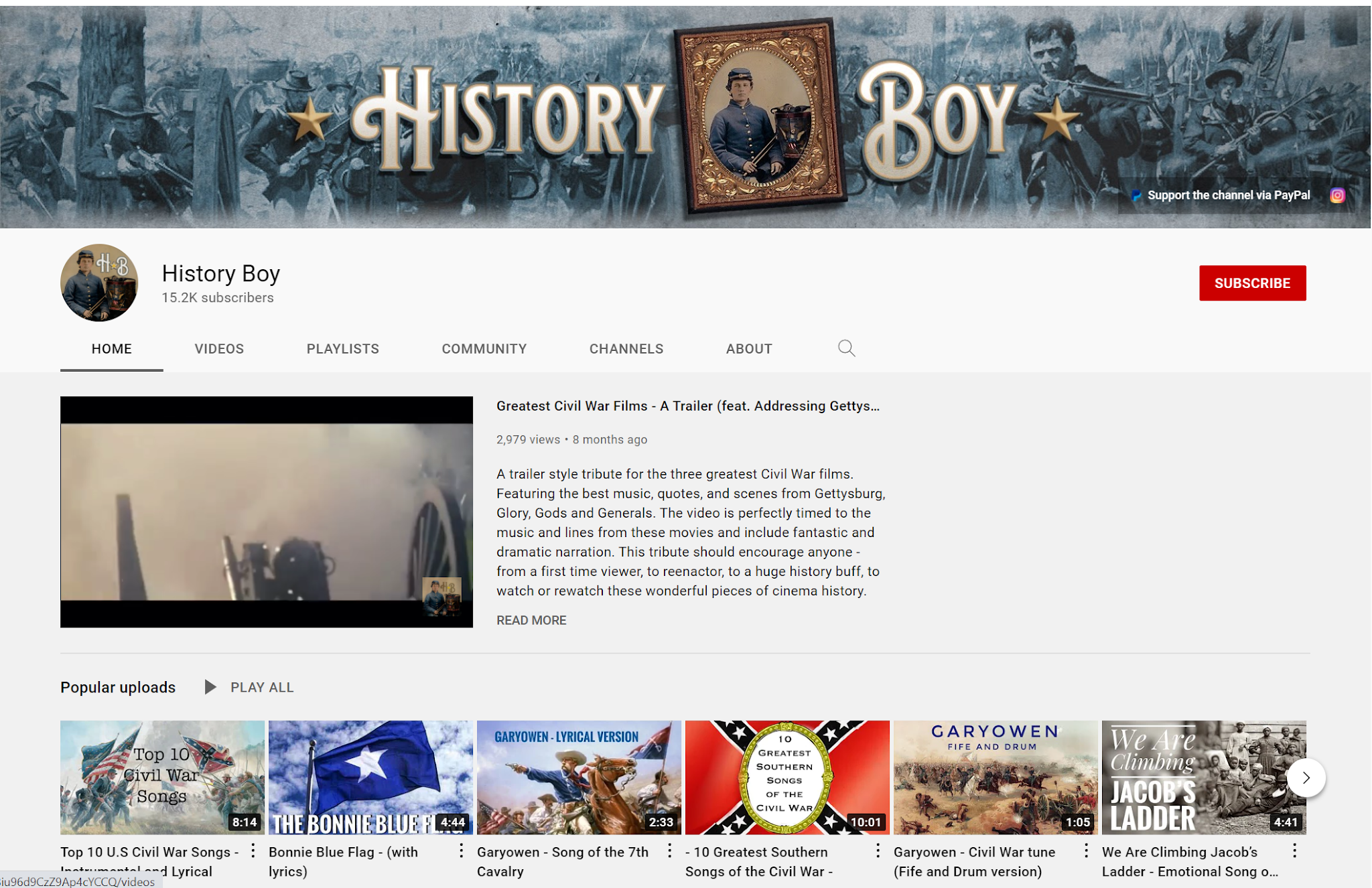
7 Questions With YouTuber History Boy, AKA Jacob


History Boy (a.k.a Jacob) has been creating historical videos on YouTube since the age of 11 years old. With a deep passion for Civil War history, he became a reenactor at the age of 13, and now at 15 years of age, he is still a committed drummer in the 8th Connecticut Volunteers, (8CV.org) a reenactment group in Connecticut. History Boy posts historical music videos and narrated videos monthly, and always likes to share historical content with his kind and educated community. Access his YouTube channel at https://www.youtube.com/c/HistoryBoyHB/featured


1.          How and when did you get hooked on history?


I have been hooked on history for as long as I can remember. At first, I was fascinated with the American Revolution, and still am to this day - however, toward the age of six, my interest began to wander into the 19th century and landed on the Civil War. The American Civil War is still my favorite time period to this day, though I find all aspects of American history fascinating. I started out by reading books, and watching documentaries like “Civil War Journal.” I also loved playing with toy Civil War kepis and rifles - which you now will catch me doing in a much more serious and professional way at Civil War reenactments.


(Jacob seated)


2.          What role does history play or has it played in your personal life?


History is more than just a hobby, and is something that I find and carry with me in all aspects of my life. I teach and discuss history with my friends all day at school, learn about it in my free time, reenact it on the weekends and am even the editor of the newsletter for my reenactment organization - “Attention Company!"


3.          How does history play  a part of your professional life/career?


My YouTube channel is based primarily on the history and music of the American Civil War. Through this channel I have gotten incredible experiences such as meeting the band manager and lead banjo of the 2nd South Carolina Stringband - the world famous Civil War Camp band. I have also been able to meet many amazing people, be interviewed by the Untold Civil War podcast, and am currently collaborating with multiple big-name YouTubers, podcasters, and reenactors, to bring my audience an exclusive Civil War documentary. 


4.          Why is studying/knowing history important?


Studying and knowing history are vital for future generations - because without knowing the past we can never truly know where we came from and embrace our future. In my videos and social media posts, I always try to raise awareness for historical events, figures, and reenactments, so that my viewers are always learning (or hearing) something new!


5.          What is your favorite period or aspect of history to learn about and why?


My favorite period in history to learn about by far is the American Civil War. It is simply filled with so many incredible people, places, and events, that one can never learn enough! In addition, there are amazing reenactment events commemorating the war, and allowing participants to live the life of a soldier during the time period, which is so exciting, and which offers new opportunities for research. 


6.         How did you become a civil war reenactor and “History Boy”?


In third grade, my friend Joey gave me the name “History Boy,” due to my fascination with all things history. During my 6th grade year I received a comment on YouTube encouraging me to become a Civil War reenactor. I had previously looked into this opportunity, but decided to try again - and found a new website from a regiment named the “8th Connecticut Volunteers, Co. A” (8CV.org) that had just been put up. I was amazed by it, and with all information about the hobby provided - I sent an email to the recruiter who is now a good friend. The rest is… history!


7.      What do you hope subscribers to your YouTube channel and your social media followers to learn from your content?


From my content on YouTube and on social media I hope that my subscribers gain an appreciation for the history and music of the American Civil War. Using modern and classic methods, I educate future historians, and current history buffs.