Showing posts with label #History. Show all posts

Friday, February 25, 2022

7 Questions with Johanna Porr, Public Historian


Johanna Porr is the Orange County Historian in New York State. New York is the only state in the United States with a Local Historians Law (Arts and Cultural Affairs Law, Section 57.07) which was established in 1919 to ensure that every local government appoint an official historian to care for their historical archives and resources and act as keynote for important community commemorations. The duties of County Historians are wide and varied but include things like researching public inquires, writing and publishing local histories, speaking at important events, educating the public through programs and partnerships, and supporting historic preservation causes in the region. I serve at the pleasure of an elected County Executive and report to an elected County Legislature. Her work therefore supports the initiatives of the County government,  and she is often asked to provide historical context that may be relevant to contemporary policies and decision making.

Her website johannayaun.com explains more about her resume and projects.
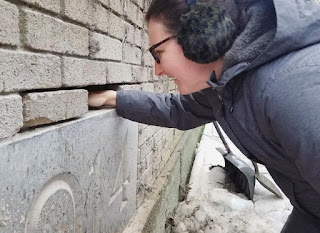
Peering into the wall of the Masonic Temple in Newburgh, NY while extracting a time capsule from behind the datestone.


 1. How did you get hooked on history?

1.     I started on the path of public history when I was given the opportunity to work as a summer tour guide at Washington’s Headquarters State Historic Site in my home city of Newburgh, NY. I was a teenager and had no experience at all but the staff believed in me. They put a stack of Revolutionary War history books and site tour templates on the table and told me to study for two weeks then see if I’m comfortable giving tours. General George Washington and the events of the American Revolution quickly became my passion and I stayed on for seven years while working my way through college. I majored in Anthropology and Archaeology and got my history training and exposure through that tour guide job. Working in a learning environment opened my eyes to intellectual professions and provided me at a young age with several mentors who have helped me to succeed as I’ve taken on more responsibility through the years. My path wasn’t a straight line, I attended study abroad programs in Europe including receiving a degree from Franklin University in Lugano, Switzerland and went to Williamsburg, VA for a summer to study at the Jamestown Rediscovery field school, I was then employed for two years as the director of the Historical Society of Newburgh Bay and the Highlands before my appointment to the current position in 2014. Recently through my capacity as Orange County Historian, I’ve taken on the role of Chair of the Orange County Semiquincentennial Commission and find myself immersed once again in thinking about how to translate academic scholarship about the American Revolution into practical local programming. Renewing the friendships and professional circles that I had developed through my work at Washington’s HQ as I plan for this 250-year commemoration, has shed light on just how special and meaningful those years at Washington’s Headquarters were to my professional foundation.
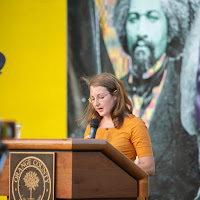
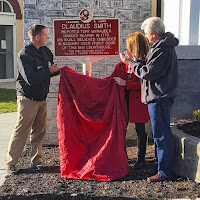
 (left) Keynote speaker at the 150th anniversary of Frederick Douglass’ jubilee march through Newburgh, NY marking the passing of the 15th Amendment. (right) Unveiling a Legend and Lore historic marker from the Pomeroy Foundation in front of the 1841 Courthouse in Goshen, NY with County Executive Steve Neuhaus and Town of Goshen Historian Ed Conner


2.  What role does history play or has it played in your personal life?

My home city of Newburgh, NY is a place that has struggled for more than 60 years. It was afflicted by the ills of suburbanization, car culture, redlining and by a devastating Urban Renewal free-for-all that destroyed over 1,300 addresses and left behind a collective trauma from the displacements and loss. The crime and poverty that I witnessed as a child and lack of opportunity for young people inspires me every day to forge a path for others to rise from the disadvantages into worthwhile careers. The City of Newburgh is a Hudson River city full of untapped potential for public history, historic preservation, historic trades and heritage tourism jobs. Not only do we have General George Washington’s longest wartime headquarters (established as the first publicly owned historic site in the Nation in 1850) but we also have New York State’s largest contiguous historic district which is full of authentic architecture built by (Newburgh native) A.J. Downing, Calvert Vaux, Frederick Clarke Withers, A.J. Davis, etc. Public history gives me hope that by embracing our past, my struggling city can once again create a thriving downtown that employs and inspires our diverse and impoverished youth.


3.    What role does history play in your professional life?

 My career in public history has presented me with opportunities that I wouldn’t have had otherwise. What I find the most joy in is being able to be the bridge between worlds. I have helped neighborhood families to fly kites for the first time at the annual Kites Over the Hudson celebration at Washington’s Headquarters, but I’ve also shared a luxurious Manhattan meal with a bestselling author as he picked my brain for ideas. I’ve worked 3 part time jobs at once while trying to cover tuition and still have enough to buy groceries, but I’ve also been invited to serve on grant panels and decide where big money gets allocated. I’ve shared my archaeological findings with giggling Kindergarteners, but I’ve also driven 800 miles with artifacts in my backseat to present to a group of discerning academic scholars. Seeing how people live and work in a wide range of scenarios has empowered me to feel comfortable asking for help and making connections between unlikely groups. My professional career in historic preservation has tapped my versatility and creativity and after almost twenty years in this line of work, I feel confident that I can take on any challenge.
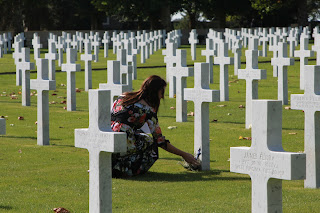
 

Placing flags on the graves of the local soldiers who were killed in action at the Battle of St. Quentin Canal in the Somme American Cemetery in France.


Teaching Boy Scouts in proper techniques for gravestone cleaning at a workshop in Deerpark, NY

4.     Why is the study of history important?

I am of the opinion that it is important to study history because it is endlessly interesting. Learning one thread of a topic, leads to another and another and another. The more you know, the more you want to know. The more you want to know, the more you question the ‘way things are’ and seek to uncover universal truths. The more you uncover, the more interested you become in the human condition. The more interested you are with other people’s circumstances, the deeper your ability to feel the empathy, comradery and the bonds of trust that transcend time, place and culture. Feeling connected to something larger than the self will elicit a sense of duty to use your knowledge to stand up for what’s right. Studying and teaching history democratizes knowledge and empowers communities to know when activism and action is necessary.
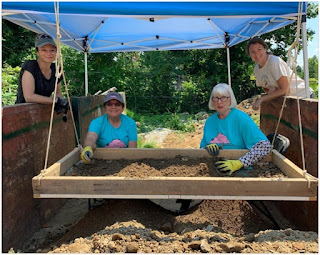
 

With CRM archaeologist Kristin Clyne-Lehmann and two of our neighborhood volunteers at the public archaeology dig at Weigand’s Tavern in Newburgh, NY


5.     What is your favorite time or place of history to study?

When I travel I am drawn to ancient Mediterranean cultures such as Egypt, Turkey, Croatia, Greece and Italy. I find myself at ease in the countryside museums and open-air collections, and enjoy the foods, the languages, oral traditions and perspectives on time. But as far as choosing a time period that piques my intellectual curiosity-- I would have to say it’s the Great War/ World War I. It’s a topic that showcases the highs and lows of society. The optimism and triumph, the regrets, the trauma, the injustices, the wasted lives. The contrasts of modern warfare set into a period where aviation and motion pictures were only budding technologies.  It’s also astounding to look at the ways in which art, journalism, medicine and other aspects of our contemporary culture were altered by the war. It seems to me that we are still living in an era shaped directly by World War I. This interest has led to creative local history programming. In exploring this interest during the centennial period, I planned and hosted a trip to Belgium and France. Exactly 100 years to the day after 43 soldiers from Orange County, part of the 107th NY Infantry Regiment, perished together at the Battle of St Quentin Canal on Sept. 29, 1918, our group of historians, veterans and descendants of World War I soldiers followed in the footsteps of the men. For 10 days we visited landmarks and learned about their experiences in the war, then arrived at the Somme American cemetery to place flags on the graves of the fallen. Simultaneously local veterans placed wreaths on the graves of World War I soldiers buried in Orange County and, perhaps surprisingly, the Newburgh Brewing Company also hosted a history event in their taproom and dedicated a beer to a well-known soldier named Pvt. Walter Allison who had died that day. A history and photo exhibit at the Orange County Government Center is now on permanent display. But the 107th Infantry Regiment was not the only regiment who sent local men into battle, so in 2023 I’m hosting another trip to Europe to follow in the footsteps of the men who fought in the 369th NY Infantry Regiment including Pvt. Horace Pippin who grew up in Goshen, NY. The tour is open to anyone who wants to travel and learn with a group of history lovers, sign up—you won’t regret it!


6.     Your Instagram account is called "Life of a Public Historian." What exactly is a public historian as opposed to just an historian?

It’s often said that the historical professions are made up of sharers and hoarders. I am a sharer to the most extreme degree. I want everyone to get the same satisfaction and fulfillment out of learning that I do.  So the “public” in Public Historian is a very important distinction. My Instagram account @lifeofapublichistorian is a place to share the unique and interesting topics, places, scenarios that I find myself in through my work. But I also have another Instagram account @newburghbydesign where share the history of the built-environment of Newburgh, NY which is often at the front line of historical preservation activism because of the reality that it is hard to maintain New York State’s largest historic district under pressures of widespread economic hardship. The group of supporters who follow me on that account came through and saved a historic building just last week – in 24 hours’ time, I was able to go to City Hall with a binder of 100 letters of support and over 1,500 petition signatures asking for the city to reconsider a demolition. In addition to working, volunteering and restoring my own 1917 historic Tudor home in Newburgh, NY with my husband and son, I also teach ‘Intro to Historic Preservation’ in a historic trades program at SUNY Westchester because in order to authentically expand widespread understanding of the importance of public history, agency and knowledge must be passed the hands of next generation.
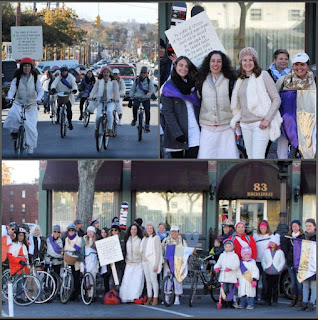
 

Commemorating the centennial of women’s suffrage with a community bike ride down Broadway in Newburgh, NY

7.     In your opinion, what is the state of public history and preservation awareness and consciousness today? 

History and historic preservation is popular and viable in our contemporary world. The problems that we face in harnessing the potential have to do with communication and employment barriers. If the school districts, local governments and tourism bureaus put more resources into empowering young people, especially through employment in historic trades and heritage tourism professions, a generation of public historians would thrive and they would make our communities stronger. Whenever it is possible, I invite everyone to be part of uncovering history, and in the most literal sense this summer I invited the public to participate in an archaeological dig in Newburgh’s historic district. The adults and kids who volunteered to sift through the dirt and sort artifacts had an unforgettable hands-on experience that changed their understanding of their neighborhood. Give the public the chance to be community stewards of historical memory and resources, and  they will rise well above our expectations. 


Friday, January 14, 2022

7 Questions With Pat Young, The Reconstruction Era Blog


Pat Young writes The Reconstruction Era Blog and The Immigrants' Civil War. He is Special Professor of Immigration Law at Hofstra Law School in New York and he works to provide services and advocacy for immigrants in New York City, Long Island and the Hudson Valley. ( Reconstruction Era  https://thereconstructionera.com/ , Immigrants' Civil War https://longislandwins.com/immigrants-civil-war/ )


1. How and when did you get  hooked on history?


Like a lot of older white men, I date my interest back to the Civil War Centennial (1961-1965). Since I was only three when the Centennial started, I must have caught the tail end of it. Over time my interest in history matured and I studied the histories of a number of civil wars, and looked at their aftermaths. I was in-country doing human rights research during one civil war, and my wife’s uncle fought in another, the Spanish Civil War, in the “Abraham Lincoln Brigade.” I have interviewed thousands of people who fled civil wars. Most of what I learned told me that the sanitized stories of the American Civil War did not match how people experience the trauma of civil conflict. 


I also learned that the post-war world in countries torn by civil war is not a time of healing. Often the war continues by other means. I thought that further study of the American Civil War and Reconstruction Era might turn up information that was not accounted for in what I learned as a youngster. 


2. What role does history play or has it played in your personal life?


I am a lawyer and all lawyers are involved in the use of history. When we cite precedents, we are using legal history to support our case. Pulitzer Prize-winning historian Jack Rackove calls this “Law Office History,” but it is important for the lawyer to understand the history of a statute to suggest its correct interpretation to the court. 


History has also been important to my life in another way. The immigrants I work with are often the targets of marginalization both because of their race and because of anti-immigrant hatred. Understanding how current concepts of race developed over American history helps me counter implicit bias in modern legislation and law enforcement. Understanding xenophobia from the Know Nothings to modern movements like the Proud Boys helps untangle the arguments of the rhetoricians of hatred. 


3. How does history play  a part in your professional life/career?


My lectures on immigration law at Hofstra University are steeped in the history of the law’s development. In its immigration laws, America wears its heart of darkness on its sleeve. As I tell my students, you can’t understand the Chinese Exclusion Act unless you understand the fevered and deadly hatreds aroused against what was, after all, a very small group of immigrants. 


I recall several years ago being introduced by one of the leaders of Hofstra University’s history department as “a great historian” and being more thrilled by that than by any other introduction I have had in my life. History is important to me. 


4. Why is studying/knowing history important?


Our institutions and laws were developed at specific times in American history. We can’t understand them without knowing the history behind them. If we look, for example, at Alabama’s current constitution we need to  know that its adoption was advocated for by the man most responsible for passing it with these words: “The new Constitution eliminates the ignorant Negro vote and places the control of our government where God Almighty intended it should be — with the Anglo-Saxon race.” Our laws often embed discriminatory intent within legalistic prose. We need to take seriously the invidious discrimination inserted into our laws in the distant past and often still active in the legal system. 


5. What is your favorite period or aspect of history to learn about and why?


The Civil War and Reconstruction eras. This period gave us three enduring Constitutional Amendments; the 13th ending slavery, the 15th eliminating the color line in voting, and the Grand 14th Amendment. That last amendment influences court decisions every day in America. From the citizenship status of children born to immigrants to the right of same-sex couples to marry, the 14th Amendment is a beacon of equality. And it is more than 150 years old!


A lot of people love to study the Revolutionary period, but we are not so concerned today with whether we should be a colony of Britain or not. On the other hand, the issues of 1850 to 1877 are still alive. Racial distinctions, immigration, state v. federal power are all still open questions. 


6.         How did The Reconstruction Era blog get started? 


I already was blogging about immigrants during the Civil War, so I was familiar with the form. I had been posting documents from the Reconstruction Era on a message board and found that they kept getting taken down by the site’s moderators because some people found them controversial. 


I decided that if I was going to invest my limited spare time in researching the period, I needed to have control over whether the materials I developed were displayed. So I started The Reconstruction Era Blog. It quickly gained a following and last year I had more than 85,000 unique visitors from all fifty states and a hundred and fifty countries. 


I am particularly happy to note that the blog has a large following in the South. Five of my Top 10 states in terms of visitation are from the former Confederacy. The notion that Southerners won’t read the unvarnished history of Reconstruction is nonsense. Many of my most loyal readers are from Texas, Virginia, North Carolina, Florida, and Georgia. For them, this is “local history” and they tell me it helps explain the persistent cleavages where they live. 


7. What do you hope readers of The Reconstruction Era blog learn and take away with them?


I hope they gain insight into how we as a country got this way. Racial conflict did not begin in 2020. The Reconstruction Era offers us some frightful examples of the depravity that the doctrine of White Supremacy can lead us to, but it also offers inspiring stories of men and women, black and white, already working towards a world in which progress and diversity are welcome. As Frederick Douglass said in 1867, the “voice of civilization speaks an unmistakable language against the isolation of families, nations and races, and pleads for composite nationality as essential to her triumphs.” We are that “composite nation” formed from many peoples that Douglass dreamed of.


Friday, November 12, 2021

7 Questions with Clare Mulley, Author


Clare Mulley is an award-winning author and broadcaster. Her first book, The Woman Who Saved the Children, won the Daily Mail Biographers’ Club Prize, and The Spy Who Loved led to Clare being decorated with Poland’s national honour, the Bene Merito. Clare’s third book, The Women Who Flew for Hitler, tells the extraordinary story of two women at the heart of Nazi Germany, whose choices put them on opposite sides of history, and was long-listed for the Historic Writers Association Non-Fiction Crown. Clare reviews non-fiction for the Spectator and Telegraph. Learn more at https://claremulley.com/


1. How and when did you get hooked on history?


Since I saw the worn stone steps outside a farmhouse as a child, and learnt that this was caused by the women and men, children and probably animals, walking through the same doorway for centuries. That threshold still has its grip on me. 


2. What role does history play or has it played in your personal life?

My first book was a biography of Eglantyne Jebb, the remarkable founder of Save the Children and champion of children's human rights, who was not fond of individual children yet permanently changed the way the world both regards and treats the younger generations. I was working for Save the Children as a fundraiser when I came across her inspiring story, heard about her public arrest, her passion and compassion. The book, called The Woman Who Saved the Children, later won the Daily Mail Biographers Club prize, and turned me into an author. All royalties from that book go to Save the Children, but I now make my living from writing… and my eldest daughter is called Eglantyne after this great woman - although only as her middle name! So even just this particular history alone has had a huge impact on my life!


3. How does history play a part of your professional life/career?

I am not exactly sure what qualifies someone to be a historian. When I started researching my book on Eglantyne Jebb I took a history Masters degree, writing almost every essay on my subject! Although I have not gone on to get a Doctorate, I have now published three non-fiction history books. After The Woman Who Saved the Children, came my biography of Krystyna Skarbek, aka Christine Granville, The Spy Who Loved. Granville was the first woman to serve Britain as a special agent in the Second World War. She worked in three different theatres of the conflict, escaping arrest in Nazi-occupied Poland before being parachuted behind enemy lines in France, were she secured the defection of an entire German garrison and saved the lives of several of her male colleagues among other achievements. Awarded the OBE, George Medal and French Croix de Guerre, she was reportedly also Churchill’s ‘favourite spy’. Researching this book dominated my life for two years, and Granville has never left me - I unveiled an English Heritage Blue Plaque for her last year. 

Deciding to take a different perspective on the war, my last book, The Women Who Flew for Hitler, looked at the intertwined lives of the only to women to serve the Third Reich as test pilots, one of whom was a fanatical Nazi, while the other secretly had Jewish ancestry and became involved in the most famous attempt on Hitler's life. I am now working on my next book - but this is still under wraps. Needless to say, history has not only been core to my professional life for the last decade or more, it also seeps into much of the rest of my life too, be it the stories I share with my daughters, the places I choose to holiday, and even, sometimes, the narratives of my dreams! 


5. What is your favorite period or aspect of history to learn about and why?

The obvious answer to this is the history of women engaging with and responding to the First and Second World Wars. However, in truth I am fascinated by all recorded history, from handprints on cave walls onwards. I love to learn from experts in other periods and areas, and am often inspired by both the evident similarities and differences that distinguish human history across time and place.


6. Your work, books, articles, and reviews, mostly revolves around women during World War II, extraordinary women who are pretty much left out of general history. What attracts you to their stories and how much more difficult is it to research their stories?

There is still a rich seam of untold women’s stories across history, including what is sometimes called 'military history'. The First and Second World Wars both to some extent subverted usual gender norms, enabling British women not only to serve on the Home Front but also to take roles at the frontline or even behind enemy lines. The expediency of war is a great leveller, and it is always fascinating looking at such moments of great social change. For Polish women, the Home Front quickly was the frontline, and many served within their military as pilots, drivers and soldiers. Soviet women were also recruited into frontline service as fighter and bomber pilots, tank drivers, snipers and machine gunners. Yet stories such as these have received relatively little attention, or are still told through a glamourising lens: the women discussed in terms of their beauty and courage, rather than their achievements. It has been a privilege, as well as a great adventure, to research and write some of this history from a fresh perspective. This is not just 'women’s history', it is shared history, and sheds light not only on female endeavour but on diversity in terms of nationality, race, faith, age and physical ability, and also on the 'male experience' of war! 

Regarding researching women’s stories, there tends to be less material on the women who served in the archives, even proportionally, although there is now an increasing will to capture and retain more of this. Conversely however, I have sometimes found more material on the women kept with families, such as personal diaries, letters and other documents. I once found a document on a servicewoman marked ‘file as domestic’, which is pretty telling in itself! 


7. You also review books for numerous publications. From your point of view as a reviewer, what makes for a successful history book?

I enjoy reviewing, and this year I am also Chair of the judges for the Historical Writers Association Non-Fiction Crown prize, which has been like being part of the best - and most intense - book club ever. Different book prizes may look for different qualities, such as how accessible a book is, or how deep the research or fresh the perspective. I am interested in all these things, as well as the the basics such as fine, fluent writing, but I think it is also important to judge each book on its own terms. At the end of the day, what is really needed is multiple perspectives on the various subjects. I am always suspicious of any book that claims to be the definitive authority on any subject!  


Friday, October 8, 2021

7 Questions with James Cosgrove, Project Past on YouTube


    James Cosgrove was raised in Florida and became a firefighter/paramedic right after high school. He's entering his 11th year in the fire service. He also served 6 years in the Army National Guard as a medic for the 53rd Infantry Brigade Combat Team. He doesn't have any college degrees in history or anything for that matter, "I'm just an ordinary guy who loves military history and learning. I've learned pretty quick I'm not that smartest guy in the room. I started Project Past because it helped me combine 2 of my passions, History and videography. Its been a blast filming and I've learned so much already. I hope my small group of viewers has learn as well. History can teach us so much. The good, the bad and the ugly."  (YouTube page https://www.youtube.com/channel/UCz1rMpe1CbMgZ7ZTRV6aRfQ 

1. How and when did you first get hooked on history?

 Ever since I can remember I was the kid running around the neighborhood with a toy gun pretending to be Francis Marion battling the redcoats. When I was not outside you could find me playing with the thousands of plastic soldiers I had or watching war movies/history channel. My dad was a pretty big history buff so I think that's where I got it from.  


2. What role does history play or has it played in your personal life?

Well my dad was a huge history buff and we definitely were able to form a bond visiting sites together or watching Gettysburg as a kid. I think having this bond has helped me understand history is not always glorious or filled with happy moments no matter how bad we want it to be. My fiancé is also a high school International Baccalaureate teacher and obviously we hit it off when we found our mutual love for history. We plan on traveling to historic places around the country. 

3. How does history play  a part of your professional life/career?

The fire service is huge on tradition and history. So when I became I firefighter in 2010, it was really easy for me to learn and understand these traditions. Its very important for newer firefighters to carry on these traditions and continue to uphold the oath we took to serve the public. 


4. Why is studying/knowing history important?

I think studying/knowing history is critical for society to continue to progress in a positive direction. History has taught us just how cruel and evil humanity can be at times. If we don't learn from these moments we are doomed to repeat them.     

5. What's your favorite period of history to learn about and why?

My favorite period in history is the American Revolution and the American Civil War. While war itself is terrible, these periods teach us how ordinary people can band together and fight for something so much larger than yourself.

6. How did Project Past come about?

My adult life has been consumed with work and my professional development. I've been neglecting my hobbies and interests for a long time now. Then, one day last year I came across JD's "The History Underground" YouTube channel and realized that this is what I wanted to do. While I will never be on the same level as JD's channel, I wanted to get out there and explore and most importantly, learn. 


7. What do you hope viewers take away from Project Past?

My YouTube channel (Project_Past) is about getting out in your community and learning from the history that's entrenched all around us. Ignorance is something that I fear is becoming more common so I hope to combat some of this by sharing stories and places we often overlook or take for granted. I plan to film throughout the country and visit battlefields, museums and places that have shaped our country. Our country has come a long way but we still have so much more work to do!


Friday, September 10, 2021

7 Questions with Jason Fegadel of Youtube Channel Byztory


Jason Fegadel runs Byztory, a YouTube channel featuring animated videos about the Byzantine Empire ( https://www.youtube.com/c/Byztory). He works as an Archive Specialist in the Electronic Records Division at the National Archives and Records Administration. A native of Rochester, New York, he currently lives in the Washington, DC area with his wife and three children. 


1.          How and when did you get  hooked on history?

Fun story! When I was about 7 years old, my family visited Boston and while we were there, we attended a reenactment of the Boston Tea Party. For whatever reason, this just fascinated me. I had all kinds of questions for my parents afterwards and wanted to learn everything about it, why it happened, and what happened afterwards. I soon started looking for books in the school library about that era and then I started to move into whatever other history-related media I could find. As I got older and studied more, my primary interests moved away from early American history but that was the beginning of my life long interest.


2.          What role does history play or has it played in your personal life?

We live in the Washington, DC area so there are plenty of museums, parks, and sites that we can take our kids to. When we visit these places I get to talk their ears off explaining all about the history that they are seeing.


3.          How does history play  a part of your professional life/career?

I'm very lucky to have had a lot of hands-on experience working with historical materials. In 2011 I started working at the National Archives and Records Administration on a digitization project. I stayed there until 2015 when I moved over to the Library of Congress to work on digitization of their holdings. Then in 2018 I went back to NARA as an Archives Specialist working with electronic records and I'm still in that position today.


4.          Why is studying/knowing history important?

The world of today doesn't exist on it's own. We got here because of everything that happened before us. It's important to know where we came from and what brought us to this point. The foundations of the modern world can be found in the ancient and medieval world.

5.          What is your favorite period or aspect of history to learn about and why?

Anything related to the Eastern Roman Empire/Byzantine Empire is fascinating to me but I'm particularly interested in late antiquity, the period from roughly the beginning of the 4th century to the end of the 7th century. I'm fascinated by the causes and effects of the decline and fall of the western Roman Empire, both internally and externally.... what actually happened as the western empire declined, why the eastern empire was able to continue, and how Europe moved into the Medieval period in the aftermath of the fall of the western empire.


6.         How did Byztory get started?

There is a lot of good history content on YouTube, but I noticed that there wasn't a ton of stuff out there about the Byzantine Empire. There are a lot of important events that occurred in the Byzantine Empire and there are some interesting stories that can be told, so I thought it would be a good opportunity to produce some educational content. I took some inspiration from some other channels that are out there and adapted some things to fit my vision. I'm still trying to improve things but I'm happy with how it's coming along.


7.      What can viewers expect to find on your YouTube channel?


I make animated videos about Eastern Roman/Byzantine history. I try to produce videos that are roughly 10-15 minutes long, but I try to go into depth on the topics that I'm covering. As a result I have several videos in a series, with each video covering only a somewhat short period of time, or in some cases only one major event or battle. I'm currently working on a series about the Gothic War, part of Justinian's attempt to reconquer territories that were once a part of Rome's western empire. I have a lot of topics that I plan to do series on in the future, including the Schism of 1054 and the Byzantine Empire's role in the crusades.


Friday, August 6, 2021

7 Questions with Lance Geiger, The History Guy


Lance Geiger is best known as The History Guy on YouTube, producing short videos on obscure topics of history three days a week. After multiple careers in academia and the corporate world, Lance decided to transform his life-long passion for history into a channel dedicated to the idea that history does not need to be boring, reminding viewers that history deserves to be remembered and, of course, that all good stories involve pirates. To date Lance has garnered more than 130 million views and has gotten to work with top quality museums, historical sites, and The History Channel's History-at-Home series.  His videos have been highlighted by online platforms of Forbes Magazine and the Wall Street Journal. ( https://www.youtube.com/channel/UC4sEmXUuWIFlxRIFBRV6VXQ )


    1.          How and when did you get  hooked on history? 

 I was a history buff from an early age, and can't remember when I did not love history.  I credit my love of history to my father's love for war documentaries and John Wayne movies. 

2.          What role does history play or has it played in your personal life? 

My penchant for telling stories about history has been a tie that binds me in many of my personal and professional relationships.  Most notably, a passion for history was a deep shared bond with my father that has carried on with my sons. 

3.          How does history play  a part of your professional life/career? 

Previously my passion for history was a way to build relationships with clients and colleagues. Since 2017, talking about history has been my full-time career. 

4.          Why is studying/knowing history important? 

History certainly informs us and helps us make independent decisions about our present.  I cannot see a nation succeeding if its citizens forget their history.  History is also just darned good entertainment, with stories quite often stranger and more interesting than fiction. 


5.          What is your favorite period or aspect of history to learn about and why? 

I am not good at picking favorites.  On the channel I always say that my favorite bit of history is whatever episode I am working on at the moment. I am, viewers are aware, rather fond of vintage hats. 

6.         How did you become the History Guy? 

I was "in between jobs" in my corporate career and decided that I wanted to do something different. Sometimes people ask what the magic formula is for success on social media and I answer honestly that I have no idea.  I had no background in video, a little experience in tele-teaching, a computer and an idea, and I just followed my nose. 


7.      What kind of content can people expect to find from you ? 


My channel is about telling compelling stories. My content is deliberately diverse, works in a lot of science, and even wanders some into prehistory.  In a given week I might talk about an event in ancient Rome, tell a story about the Second World War, and then talk about the history of ketchup.