Showing posts with label #publichistory. Show all posts

Friday, October 7, 2022

7 Questions with Laura Macaluso, Public Historian


Laura A. Macaluso researches and writes about monuments, museums, murals, and material culture. She has a PhD in the Humanities with a focus on Cultural & Historic Preservation. She works in development for the York County History Center in York, PA and tweets @monumentculture. You can find more of her work at  www.lauramacaluso.com.


1.How and when did you get hooked on history?


Well, I'm an outlier here because my discipline is Art History, which I studied as an undergraduate and graduate student. But, I came to appreciate both sides of the name: that is, the art side and the history side. Much later, when I studied monuments (which are often equal parts art and history), I realized that public art and public history share a lot of the same ideas and practices, and now I try to keep doing a little bit of both. 

But, I want to pay homage to an early teacher here. Her name was Miss Shinko, and she taught at my Catholic school for only one year. But I know, from a blurry square photograph, that she took us to see the Temple of Dendur at the Metropolitan Museum of Art. Truthfully, I don't remember the trip, but the Temple of Dendur remains a favorite--especially now that the Met projects colored light on the stone surface, so that visitors can get a sense of how colorful the hieroglyphics would have been in the Ancient World. That is a big change from when I was a young student: museums now recognize that ancient statues, monuments, and buildings were full of color, not the bright white marble of Classical Greek statues or the bland sandstone of Egyptian temples. 

And, in terms of American history, well, let's just balance out visits to the Met with the real deal: made-for-TV miniseries such as George Washington with Barry Bostwick, North & South with Patrick Swayze, and later, Ken Burns's The Civil War, which was like religion for my history-loving husband, all played a part. As did trips with my parents to local historical sites in Connecticut like Mystic Seaport, Gillette's Castle, and Dinosaur State Park. 


2. How role does history play or has it played in your personal life?

The practice of history drives me (to distraction it feels sometimes!); because it feels so deeply embedded in the way I think and perform basic functions like reading and writing and conceptualizing everything around me. I see the good in this, but I also see the limitations. That comes with age. The practice of history has opened doors, so that I have been able to travel and be with people I never would have met in places like South Africa, New Zealand, England, and Italy. But, at the same time, I also know that history can also be narrow in the people it includes in its practice, so, sometimes it is a frustrating endeavour. I see glimpses of the world and want to apply a historian's lens to it all, but there isn't enough time, ever. 

3. How does history play a part in your professional life/career?

Yes, history does play a part in my "regular" job in a history museum, and there is a specific role to play there in Advancement, where I put project management skills to use. But, it is much more in terms of the research, writing, and publishing I work at, sometimes for money, sometimes not, which is a current and problematic discussion within many communities, from higher education to museums to not-for-profits. In 2022, the practice of history enabled me to participate in a webinar hosted by Duke University, publish a book, lecture for the Smithsonian Associates, attend a fully supported study week in Chicago, and present at the American Association for State and Local History (AASLH) conference in Buffalo. This is a typical year, and it is a good reminder, as I write this for you, that this is a position of privilege. 

4. Why is studying/knowing history important?

Is there any way to unpack what happened on January 6, 2021 without the assistance of history? It was shocking and, as yet, has not had enough historical work done around that event to begin to understand its causes, repercussions and resonances throughout not only the country, but the world. I don't know why I am honing in on this right now, when there are hundreds if not thousands of topics worthy of discussion and learning. But, I guess that's the point: I am interested in evolving discussions and continual learning. History is one tool with which to engage in that way of living. 

5. What is your favorite period or aspect of history to learn about and why?

Usually I say that whatever I am working on is my current favorite thing, and that is because it is so fresh. Recently I finished a short biography of the American artist Jeff Koons, which will appear on the Literary and Cultural Heritage Maps of PA, hosted by the Pennsylvania Center for the Book. Koons, whether you love his artwork or hate it, is the most successful American artist after Andy Warhol. And, the practice of art/history helped me think about this: Pennsylvania, a heavily rural state, produced the two most important American artists of the last sixty years, at opposite ends of the state. One artist is considered an icon of "Pop" and the other, an icon of "Neo-Pop."  What are their legacies for Pennsylvania?

I came to learn and work in Pennsylvania without knowing anything at all about it, but I've already got project ideas to last for the next few years. This is my favorite aspect of history: the histories needing to be written are just sitting there, waiting for someone with the ability to look and to question to get at it. 


6. What drew you to the field of public history?

The opportunity to work on artifacts/objects outside of the general purview of traditional historians and art historians drew me, first, to public art, and then to public history. There is room to breathe in these spaces. Boundaries can be crossed more easily. Materials are closer at hand. 

7. Why is the study of public history, and public history itself important?

Practicing public history is something anyone can do and everyone should do! Today I went to the doctor, and he reminded me why exercise is important. It is work, but, if you find something you like, it is also a joy. Doing public art/history is work, but it can also be a joy. 

Friday, February 25, 2022

7 Questions with Johanna Porr, Public Historian


Johanna Porr is the Orange County Historian in New York State. New York is the only state in the United States with a Local Historians Law (Arts and Cultural Affairs Law, Section 57.07) which was established in 1919 to ensure that every local government appoint an official historian to care for their historical archives and resources and act as keynote for important community commemorations. The duties of County Historians are wide and varied but include things like researching public inquires, writing and publishing local histories, speaking at important events, educating the public through programs and partnerships, and supporting historic preservation causes in the region. I serve at the pleasure of an elected County Executive and report to an elected County Legislature. Her work therefore supports the initiatives of the County government,  and she is often asked to provide historical context that may be relevant to contemporary policies and decision making.

Her website johannayaun.com explains more about her resume and projects.

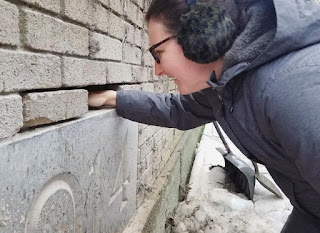
Peering into the wall of the Masonic Temple in Newburgh, NY while extracting a time capsule from behind the datestone.


 1. How did you get hooked on history?

1.     I started on the path of public history when I was given the opportunity to work as a summer tour guide at Washington’s Headquarters State Historic Site in my home city of Newburgh, NY. I was a teenager and had no experience at all but the staff believed in me. They put a stack of Revolutionary War history books and site tour templates on the table and told me to study for two weeks then see if I’m comfortable giving tours. General George Washington and the events of the American Revolution quickly became my passion and I stayed on for seven years while working my way through college. I majored in Anthropology and Archaeology and got my history training and exposure through that tour guide job. Working in a learning environment opened my eyes to intellectual professions and provided me at a young age with several mentors who have helped me to succeed as I’ve taken on more responsibility through the years. My path wasn’t a straight line, I attended study abroad programs in Europe including receiving a degree from Franklin University in Lugano, Switzerland and went to Williamsburg, VA for a summer to study at the Jamestown Rediscovery field school, I was then employed for two years as the director of the Historical Society of Newburgh Bay and the Highlands before my appointment to the current position in 2014. Recently through my capacity as Orange County Historian, I’ve taken on the role of Chair of the Orange County Semiquincentennial Commission and find myself immersed once again in thinking about how to translate academic scholarship about the American Revolution into practical local programming. Renewing the friendships and professional circles that I had developed through my work at Washington’s HQ as I plan for this 250-year commemoration, has shed light on just how special and meaningful those years at Washington’s Headquarters were to my professional foundation.

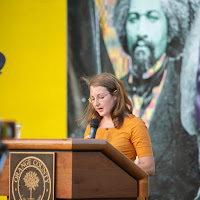
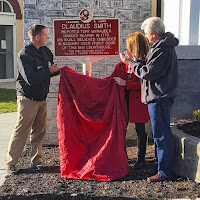
 (left) Keynote speaker at the 150th anniversary of Frederick Douglass’ jubilee march through Newburgh, NY marking the passing of the 15th Amendment. (right) Unveiling a Legend and Lore historic marker from the Pomeroy Foundation in front of the 1841 Courthouse in Goshen, NY with County Executive Steve Neuhaus and Town of Goshen Historian Ed Conner


2.  What role does history play or has it played in your personal life?

My home city of Newburgh, NY is a place that has struggled for more than 60 years. It was afflicted by the ills of suburbanization, car culture, redlining and by a devastating Urban Renewal free-for-all that destroyed over 1,300 addresses and left behind a collective trauma from the displacements and loss. The crime and poverty that I witnessed as a child and lack of opportunity for young people inspires me every day to forge a path for others to rise from the disadvantages into worthwhile careers. The City of Newburgh is a Hudson River city full of untapped potential for public history, historic preservation, historic trades and heritage tourism jobs. Not only do we have General George Washington’s longest wartime headquarters (established as the first publicly owned historic site in the Nation in 1850) but we also have New York State’s largest contiguous historic district which is full of authentic architecture built by (Newburgh native) A.J. Downing, Calvert Vaux, Frederick Clarke Withers, A.J. Davis, etc. Public history gives me hope that by embracing our past, my struggling city can once again create a thriving downtown that employs and inspires our diverse and impoverished youth.


3.    What role does history play in your professional life?

 My career in public history has presented me with opportunities that I wouldn’t have had otherwise. What I find the most joy in is being able to be the bridge between worlds. I have helped neighborhood families to fly kites for the first time at the annual Kites Over the Hudson celebration at Washington’s Headquarters, but I’ve also shared a luxurious Manhattan meal with a bestselling author as he picked my brain for ideas. I’ve worked 3 part time jobs at once while trying to cover tuition and still have enough to buy groceries, but I’ve also been invited to serve on grant panels and decide where big money gets allocated. I’ve shared my archaeological findings with giggling Kindergarteners, but I’ve also driven 800 miles with artifacts in my backseat to present to a group of discerning academic scholars. Seeing how people live and work in a wide range of scenarios has empowered me to feel comfortable asking for help and making connections between unlikely groups. My professional career in historic preservation has tapped my versatility and creativity and after almost twenty years in this line of work, I feel confident that I can take on any challenge.


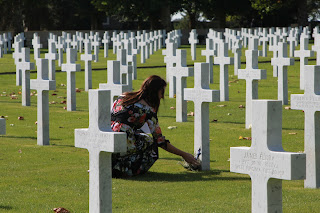
Placing flags on the graves of the local soldiers who were killed in action at the Battle of St. Quentin Canal in the Somme American Cemetery in France.


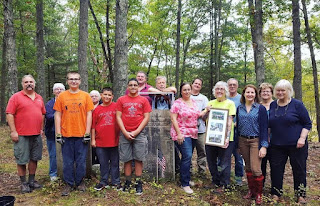
Teaching Boy Scouts in proper techniques for gravestone cleaning at a workshop in Deerpark, NY

4.     Why is the study of history important?

I am of the opinion that it is important to study history because it is endlessly interesting. Learning one thread of a topic, leads to another and another and another. The more you know, the more you want to know. The more you want to know, the more you question the ‘way things are’ and seek to uncover universal truths. The more you uncover, the more interested you become in the human condition. The more interested you are with other people’s circumstances, the deeper your ability to feel the empathy, comradery and the bonds of trust that transcend time, place and culture. Feeling connected to something larger than the self will elicit a sense of duty to use your knowledge to stand up for what’s right. Studying and teaching history democratizes knowledge and empowers communities to know when activism and action is necessary.


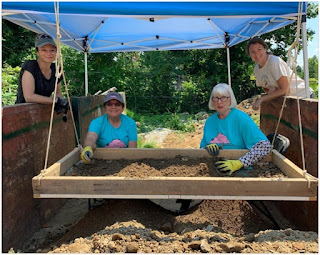
With CRM archaeologist Kristin Clyne-Lehmann and two of our neighborhood volunteers at the public archaeology dig at Weigand’s Tavern in Newburgh, NY


5.     What is your favorite time or place of history to study?

When I travel I am drawn to ancient Mediterranean cultures such as Egypt, Turkey, Croatia, Greece and Italy. I find myself at ease in the countryside museums and open-air collections, and enjoy the foods, the languages, oral traditions and perspectives on time. But as far as choosing a time period that piques my intellectual curiosity-- I would have to say it’s the Great War/ World War I. It’s a topic that showcases the highs and lows of society. The optimism and triumph, the regrets, the trauma, the injustices, the wasted lives. The contrasts of modern warfare set into a period where aviation and motion pictures were only budding technologies.  It’s also astounding to look at the ways in which art, journalism, medicine and other aspects of our contemporary culture were altered by the war. It seems to me that we are still living in an era shaped directly by World War I. This interest has led to creative local history programming. In exploring this interest during the centennial period, I planned and hosted a trip to Belgium and France. Exactly 100 years to the day after 43 soldiers from Orange County, part of the 107th NY Infantry Regiment, perished together at the Battle of St Quentin Canal on Sept. 29, 1918, our group of historians, veterans and descendants of World War I soldiers followed in the footsteps of the men. For 10 days we visited landmarks and learned about their experiences in the war, then arrived at the Somme American cemetery to place flags on the graves of the fallen. Simultaneously local veterans placed wreaths on the graves of World War I soldiers buried in Orange County and, perhaps surprisingly, the Newburgh Brewing Company also hosted a history event in their taproom and dedicated a beer to a well-known soldier named Pvt. Walter Allison who had died that day. A history and photo exhibit at the Orange County Government Center is now on permanent display. But the 107th Infantry Regiment was not the only regiment who sent local men into battle, so in 2023 I’m hosting another trip to Europe to follow in the footsteps of the men who fought in the 369th NY Infantry Regiment including Pvt. Horace Pippin who grew up in Goshen, NY. The tour is open to anyone who wants to travel and learn with a group of history lovers, sign up—you won’t regret it!


6.     Your Instagram account is called "Life of a Public Historian." What exactly is a public historian as opposed to just an historian?

It’s often said that the historical professions are made up of sharers and hoarders. I am a sharer to the most extreme degree. I want everyone to get the same satisfaction and fulfillment out of learning that I do.  So the “public” in Public Historian is a very important distinction. My Instagram account @lifeofapublichistorian is a place to share the unique and interesting topics, places, scenarios that I find myself in through my work. But I also have another Instagram account @newburghbydesign where share the history of the built-environment of Newburgh, NY which is often at the front line of historical preservation activism because of the reality that it is hard to maintain New York State’s largest historic district under pressures of widespread economic hardship. The group of supporters who follow me on that account came through and saved a historic building just last week – in 24 hours’ time, I was able to go to City Hall with a binder of 100 letters of support and over 1,500 petition signatures asking for the city to reconsider a demolition. In addition to working, volunteering and restoring my own 1917 historic Tudor home in Newburgh, NY with my husband and son, I also teach ‘Intro to Historic Preservation’ in a historic trades program at SUNY Westchester because in order to authentically expand widespread understanding of the importance of public history, agency and knowledge must be passed the hands of next generation.


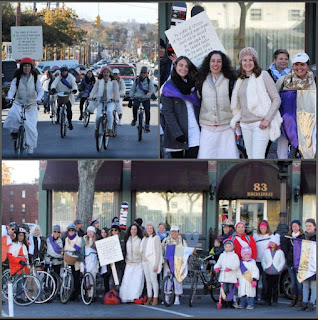
Commemorating the centennial of women’s suffrage with a community bike ride down Broadway in Newburgh, NY

7.     In your opinion, what is the state of public history and preservation awareness and consciousness today? 

History and historic preservation is popular and viable in our contemporary world. The problems that we face in harnessing the potential have to do with communication and employment barriers. If the school districts, local governments and tourism bureaus put more resources into empowering young people, especially through employment in historic trades and heritage tourism professions, a generation of public historians would thrive and they would make our communities stronger. Whenever it is possible, I invite everyone to be part of uncovering history, and in the most literal sense this summer I invited the public to participate in an archaeological dig in Newburgh’s historic district. The adults and kids who volunteered to sift through the dirt and sort artifacts had an unforgettable hands-on experience that changed their understanding of their neighborhood. Give the public the chance to be community stewards of historical memory and resources, and  they will rise well above our expectations.