Showing posts with label #podcasts. Show all posts

Friday, March 18, 2022

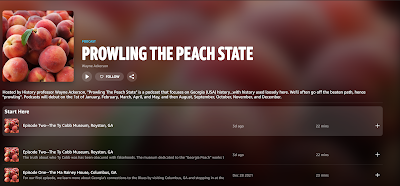
7 Questions with Wayne Ackerson, Prowling the Peach State


Wayne Ackerson was born in Corpus Christi, Texas but grew up around the world with a father who was in the navy.  He's been a college professor since 1990, teaching in Maryland and Georgia. In his spare time, he's a photographer, a minister, and enjoys reading, eating out, working out, and movies.  He earned his Ph. D. in British History from Temple University in 1999.

1.         How and when did you get  hooked on history?

Well, I was born in Texas but grew up in England, and I think living there is what did it.  You couldn’t go anywhere or do anything without being surrounded by history.  World War Two was still a big part of their cultural life, and it seemed like every TV show was about World War Two in some fashion (this was the early 70s).  I would just say that I have always loved history, for as long as I can remember.

2.         What role does history play or has it played in your personal life?

When I started college, I was a Psych major, but ended up with a double major with Psych and History.  Then onto an MA and started teaching college, then got my Ph.D. in History.  I’ve been a history professor since I was 24, back in 1990. 


3.         How does history play  a part of your professional life/career?

To say it’s important is an understatement.  It’s what I do, every day as a history professor at Georgia Gwinnett College in Lawrenceville, GA.

4.         Why is studying/knowing history important?

I am a big supporter of a broad-based, liberal arts type of education.  I believe that as citizens we should be generally well-rounded and well-informed.  In some ways, this is knowledge for knowledge’s sake.  I also believe that trends repeat themselves, and so it is useful to us to know what those are.  And of course there are practical skills which come from the study of history, such as understanding cause and effect, change over time, and being able to think critically about sources and information.

5.         What is your favorite period or aspect of history to learn about and why?

There isn’t much I dislike.  My specialty is 19th century Britain, British anti-slavery in particular.  I wrote a book called  The African Institution (1807-1827) and the Anti-slavery Movement in Great Britain which came out in 2005.  I love the Tudor-Stuart period, and ancient Greece and Rome.  I love south Asian history, which is mainly what I teach.  I enjoy anything to do with aviation (my dad was a Navy pilot).  There’s just so much to like in all these areas!


6.         What is Prowling the Peach State and how did it come about?

Prowling The Peach State is a podcast that deals with Georgia history, very broadly defined, with an emphasis on things off the beaten path.  It just seemed like a fun idea to try and do.  I don’t for a minute think I am discovering “new” things, but maybe some of the locations are ones that many people don’t know much about.  I try to put the topic or location in a broader context as much as possible, be entertaining, and also be interesting and informative.  Georgia is a state with all kinds of stuff in it, and through the series I hope to teach Georgians a few things about their relative backyards, and I’d also hope to encourage out-of-staters to visit.

I also have a companion Facebook page where I post photos I’ve taken on location, random stuff to do with that month’s topic, as well as lesson plans (questions, really) for teachers who might want to use the podcasts with their students.

7.         What can lovers of history expect in the future from Prowling the Peach State?

Well that’s a secret!  What I can say is I have a long list of topics/places I want to cover.  Most will be serious, but there’s a few bizarre ones in there too.


Friday, January 28, 2022

7 Questions With Graham Parker, Grisly History Podcast


    Graham Parker is a professional voice-over artist Contact him if you have need a voice.)and lifelong historical enthusiast. He holds a Bachelor’s in History from Georgia State University, summa cum laude.

An eagle scout, outdoorsman, and traditionalist at heart, Graham’s work on Grisly History continues an earnest pursuit of the truths we can all learn from the past. Grisly History is a long-form history podcast, with new episodes each month. Listen wherever you listen to podcasts. The website is https://www.grislyhistory.com/ .


1. How and when did you get  hooked on history?

My interest in history began when I was six years old and my father introduced me to the game of Risk. He told me that he would not let me beat him and that if I wanted to win I was going to have to learn the game. Winning that game became a big goal for me and we played often. As we played he would tell me about the different lands we fought over and about the people who had lived there throughout history which further added to my fascination with the game. It took two years before I finally won my first game, but even so I would find myself looking at globes and maps remembering what my father had told me and wanting to know more.

2. What role does history play or has it played in your personal life?

Learning history and learning about the way in which histories are compiled have had a lot to do with changing my outlook on the world. When I was young my understanding of the world and how it works was often filtered through the views of my parents and family so their understanding of the world became my understanding of the world. As I got older and devoured biographies and textbooks I began to understand that things are much more complicated than I had originally believed. As such I’ve grown more inquisitive and information oriented when reading the news or exploring a new concept.

3. How does history play  a part of your professional life/career?

I became a history major in college thinking that I might like to teach it before eventually deciding against it. Instead I used the skills that I had learned through researching and writing in administrative roles. Grisly History is the first time that I have really been able to put those skills into practice doing something that I love. I think that the podcast is as much an excuse for me to learn as it is to share stories with our audience.


4. Why is studying/knowing history important?

In a broad sense learning history is crucial to understanding how we got to where we are today. Throughout time there are triumphs and tragedies, successes and failures that can teach us not only about the world today but also inform us about the world that we would like to see. However if you want to go a step further I think understanding historiography, or the study of historical writings, is just as important. Understanding what information historians have chosen to highlight or omit can give one a better understanding of why we think about history the way we do.

5. What is your favorite period or aspect of history to learn about and why?
I love reading about the 19th century, particularly in regards to America and Europe. I find the formation of industrial technology, nation building, and colonization of that era incredibly fascinating, especially considering how all of that set up the grand conflicts and societal movements that came in the 20th century.


6. How did the podcast Grisly History come about?
The podcast came from a desire to make history more relatable to people who weren’t fond of it in school. Often when speaking to people who didn’t like history class they often say something to the effect of, “It was just memorizing names and dates, I don’t get what the big deal is.” If that is what history class was like for them then I get it, there is no point in memorizing names and dates if you don't understand the bigger story that they are a part of. I want people to be able to connect with history so Michael and I are trying to create a podcast that's immersive. We try to create a sense of dread or urgency when building the narrative and use second person pov portions to drop the listener into the story, and remind them that these things happened to people just as real as you or I.

7. What do you hope your podcast listeners take away from listening?
This is a podcast for people who want to explore darker parts of history and see why those stories are still worth discussing today. It is easy to think of the people we learn about in history as one note characters, heroes or villains in a story as we strive to attach meaning to their actions. But the truth is that they were human beings with their own lives, convictions, and desires. I hope that listeners will see the humanity of the people we discuss and come away with a better appreciation of their motives and struggles.


Friday, December 3, 2021

7 Questions with Michael Ruiz, Grisly History Podcaster


 Michael Ruiz is a writer and marketing professional based in Atlanta, Georgia. When not working, his hobbies primarily focus on mass communication projects, with production credits on several podcasts as well as writing for stage and film.  In September, he and Graham Parker started the "Grisly History" Podcast.  "Grisly History" is a monthly, long-form podcast. ( https://www.grislyhistory.com/main ) Find it wherever you find podcasts.


1. How and when did you get hooked on history?


History has always been a part of my upbringing in many ways due to cultural intersections in my childhood home.


I was primarily raised by my mother and stepfather, who had two distinctly different cultures. My mother (as I am) is purely Puerto Rican in ethnicity–holding onto that culture tightly and teaching me about my heritage daily, while raising me in Georgia. My stepfather on the other hand was from a proud American military family. He would often share stories of his father quite literally freeing victims of the Holocaust from concentration camps.


So, on one hand, I was given this idea of American Exceptionalism, and an ideation on fundamentally “American” values of justice and liberty. But on the other hand, I learned very early on that my own cultural heritage stems from an island nation traded between two larger colonial forces as a result of war. I found myself very conflicted on how to feel on all of this, and I think the time I spent as a kid wrestling on these things instilled a lifelong interest in history and the impact of previous events on our cultures, nations, and ideals. 


2. What role does history play or has it played in your personal life?


Building off of what I said as it pertains to my childhood, I think history has really informed my personal feelings of identity, heritage, and culture. I always felt like I was torn between embracing a culture I was raised in but have no blood claim to or embracing a culture I was born from but had no experience with. And I think history helps with these sorts of identity crises because we can see that every nation’s culture and identity is a complex web of international, geographical, or other influence.


I think history and the study of it has helped me see a broader picture of the world, which has in turn informed my views on everything from culture to politics. I believe Mark Twain came up with (or popularized) the idea that travel is the death of ignorance, bigotry, or prejudice. And I wholeheartedly agree–but the study of history empowers us to travel without ever leaving our homes. To get those broader experiences under our belts and get out of the narrower mindset that forms by looking only to what you have experienced alone.


3. How does history play a part of your professional life/career?


I have found history to be important in a more subversive manner in my professional life. I work in marketing, so of course much of my work is for an American audience and my knowledge of American history informs that. But my company is very international–we have people from every inhabited continent on our small team. The other day my co-worker asked me to describe “the American culture,” and I found myself continuing to talk about the history of the United States to bolster my views on the subject.


4. Why is studying/knowing history important?


I’ve essentially already said this, but I think history is our window into why people think the way they think, feel the way they feel, vote how they vote, etc.


It’s helped me understand the differences between my parents on their own worldviews, for example. And I think, in an increasingly divided age in this country, it’s critical to take a look at those diametrically opposed to you and explore what they were taught and who they were taught by to come to their conclusions. In that same vein, it’s important to take a look at yourself as well.


It’s a lot easier to exercise patience with those you may disagree with when you understand they have their own reasonings–possibly very good and valid reasonings–to view things differently than you.


5. What is your favorite period or aspect of history to learn about and why?


This comes from a biased perspective on my own education, but I love learning about Chinese and Japanese history–particularly leading up to the 20th century. It’s not something I was taught much in school, and I think in my area, it’s a history very few people explore. Particularly regarding Chinese history, I feel somewhat embarrassed to claim to love history and now produce a history podcast yet know so little about the most populous country in the world.


6. How did you decide to start the Grisly History podcast and, briefly, what's involved in starting up?


Grisly History was Graham Parker’s idea initially, and I think the process of starting it up was mostly focused on figuring out the format, structure, and what we both wanted out of it.


Graham and I go back about ten years now, so working together was a no-brainer. But I was really excited about the prospect of getting a history podcast together, as shows like Dan Carlin’s Hardcore History have just amazed me with the scope of the stories and the depth of information shared. I had the technical know-how to put the show together, and Graham had a clear vision for research and development, so the collaboration made a lot of sense.


I really enjoy the challenge of it, too. We’re talking about real stories, and real people, so the fidelity to the truth must be the top priority. At the same time, the process of culling through Graham’s research and finding the narrative to tell isn’t easy.


As with any show, you must pick and choose your phrasing carefully and determine what gets more or less emphasis in order to fit the time frame and the scope of the work. We’re trying to give an overview that’s faithful to the truth, but clear to those who aren’t familiar with what we’re talking about. It’s a balancing act, but a terrific challenge.


7. Why should listeners listen to your podcast and what do you think they will take away from it?


We want people to learn about history they’ve never heard before. We just finished up our series on the USS Indianapolis, and that’s likely the most “famous” event we’re going to cover for a long time, and even then, we had people contact us to share that they hadn’t even heard of the story beyond “Jaws.”


There are so many real-life stories that aren’t taught to us as kids not because of any malicious intent or not because they aren’t interesting, but due to the limitations of what can be taught in a certain time frame. And I think our format focuses on putting humanity back into things–sometimes going into second person to really paint the mental image and showcase that these things really happened.


Mostly, I hope that our podcast acts as a conduit for people to begin to research these things as we have and so many others have. It’s a fascinating world out there–always has been. You just have to take the time to learn about it.

Friday, July 16, 2021

7 Questions with Michael Troy, host of the American Revolution Podcast


    Michael Troy is host of the American Revolution Podcast (  https://pod.amrevpodcast.com/ ) and a member of the American Revolution Round Table.  He lives in southern New Jersey and works in Philadelphia.  He is also a former Associate General Counsel for the Center for Individual Rights.


    1.          How and when did you get hooked on history?


I’ve loved history my whole life.  I remember reading a children’s biography of Christopher Columbus at age 4.  My parents took me to visit Mount Vernon a couple of years later and I was completely hooked.


2.          What role does history play or has it played in your personal life?


History has always been a source of enjoyment.  I devour historical nonfiction as much as I can.  I love the stories and understanding how human history has progressed.  Schools usually just cover the bare bones facts about history.  I am more interested in the stories about people and their lives.  History, for me, is more interesting than fiction.  Sometimes the plots of some stories are unbelievable, and yet they really happened.


3.          How does history play a part of your professional life/career?


My professional career has been in the law and IT.  So history plays relatively little role there.  Unfortunately, I’ve never found a way to make a living in the history field.


4.          Why is studying/knowing history important?


I like the saying that history doesn’t repeat itself, but it often rhymes.  We see many recurring themes in history.  Many conflicts and resolutions to past problems have very real precedential value to many issues we experience today.  We can learn from and adapt the historic solutions of what worked or not, unless we forget those earlier lessons.


5.          What is your favorite period or aspect of history to learn about and why?


As you might guess from the theme of my podcast, I’m particularly interested in early US history.  The transition from the medieval world ruled by monarchs to the modern world where democracy took root is particularly fascinating for me.  The growth of the United States from its early colonial roots to world power in a relatively short time is nearly unprecedented in world history.


6.         How did The American Revolution Podcast get started?


Many years ago, I started a blog called “Unlearned History.”  I tried to write about interesting tidbits of history that generally were not taught in school.  After doing that for a couple of years, I thought that doing a deep-dive into the American Revolution would be fun.  Initially, I planned to publish it just as a blog.  Writing about it was a way of sharing with others what I was learning.

The decision to turn it into a podcast was almost an afterthought.  I am a fan of Mike Duncan’s podcasts.  When he began “Revolutions” I was very much looking forward to his coverage of the American Revolution.  But I found that he covered it too briefly and without the detail I wanted.  I decided that if no one else was going to do a detailed review of the American Revolution as a podcast, then I would.


7.      What can listeners expect to hear on The American Revolution Podcast?


I take listeners through the American Revolution chronologically.  I started with an overview of the French and Indian War, then the pre-war protests, then into the war itself.  I’m about half-way through the war at this point.


In each episode, I try to tell an interesting story that can stand on its own.  At the same time, I try to put the war in context, so that people can see all the political, social, economic, and other events that surrounded them as they made their way through the period.  The podcast is really unique because of its focus on the smaller events and lesser known issues, rather than just covering the major battles and political events.  I try to inject a bit of humor at times, but really let the story tell itself.  


Friday, July 9, 2021

7, errr 4, 4 Questions with Tim Harford, Economist, Journalist, and Broadcaster


Tim Harford is an economist, journalist and broadcaster. He is author of “How To Make the World Add Up” / “The Data Detective”“Messy”, and the million-selling “The Undercover Economist”. He is a senior columnist at the Financial Times, and the presenter of BBC Radio’s “More or Less”“How To Vaccinate The World”, and “Fifty Things That Made the Modern Economy”, as well as the podcast “Cautionary Tales” in which he tells "stories of awful human error, tragic catastrophes, daring heists and hilarious fiascos." Tim has spoken at TED, PopTech and the Sydney Opera House. He is an associate member of Nuffield College, Oxford and an honorary fellow of the Royal Statistical Society. Tim was made an OBE for services to improving economic understanding in the New Year honors of 2019. While he's quick to say that he's not a historian by training, he intertwines history and economics to tell great stories. (And it's my first ever conversation - albeit, via email - with a person who is a Commander of the Order of the British Empire. Cool. -Jeff Burns)


3. How does history play  a part of your professional life/career?

I studied philosophy and economics, and more recently have worked with statistics and statistical communication too. These are important topics but I've realized that by reading more history and adding historical stories I can bring subjects such as economics and statistics to life. There's a vividness and a truth to describing how ideas or technologies emerged from and shaped a particular time and place - rather than dealing with them purely in abstract.

5. What is your favorite period or aspect of history to learn about and why?

I often find myself writing about and researching smaller stories from between the two world wars. I'm not exactly sure why, but I suppose it was a time when the modern world was coming at us fast. The economic upheaval was huge, the structure of the economy was changing, but it was also a time that offered plenty of space for heroes and villains. 


6.         What gave you the idea to start the podcast Cautionary Tales?

I wanted to tell stories about things going wrong - but also explore the explanations behind the mistakes. I'm fascinated by errors: why people make mistakes, how organizations or societies get things wrong, and the trajectory of disaster - and sometimes redemption. Mistakes make for good stories but they also make for good lessons, and if you can't learn lessons from history, what can you do?


7. What can listeners expect from listening to your podcast?

A big range of true tales of disaster, some tragic, some comic, and some - just a few - with a happy ending. Amazing music and sound design. Brilliant actors - the latest series has Jeffrey Wright as the Reverend Martin Luther King Jr, and Helena Bonham Carter as Florence Nightingale. And my aim is to keep you hanging on because you just have to know how the story ends.


Monday, April 5, 2021

7 Questions Nick D'Alessandro, Creator of the Wait Five Minutes Podcast


Since the summer of 2018, Nick D'Alessandro has been producing a history and culture podcast about the state of Florida called Wait Five Minutes. Since those early days, the show has worked with experts from across the state and country, covering life in the Sunshine State as it is and how our history has shaped us. The central goal of the show is to explore the story of Florida with affection and scrutiny, sharing who we are through how we get here.


1.     How and/or when did you get hooked on history?


It’s nearly impossible for me to pinpoint a specific beginning, as my love of history has found new beginnings at so many different ages and periods in my life. My family all loves history and has certainly imbued me with their passions. I have had some genuinely incredible teachers in my youth, teachers that made me engaged with the history I was learning. The Smithsonian visits I was able to do at a very young age certainly imprinted on me, but it’s hard to overstate the impact of my middle school history teacher, Jason Leinheiser, and my high school aerospace teacher, Bill Yucius. They taught history in engaging ways, ways that made the people feel real, made them feel present, and I often find I’m trying to match their excitement and passion in every episode I write.


2.     What role does history play or has it played in your personal life?


History has just changed the way I see everything, even little things. I’ve always loved road trips and maps, and since I started the show three years ago, I often find myself searching up the towns, roads, natural landmarks, and everything in between whenever I travel. Name origins, town placements, the most menial insignificant stuff is so fascinating because I know for a fact that everything is connected to some broader historical trend or moment. I’m lucky my partner and my family enjoy hearing me rant about the things I find or the things I notice because I can’t contain myself at most points.


3.     How will history play a part of your professional life/career?


This podcast started out as a current event show approaching the 2018 gubernatorial election in Florida. There were so many issues in Florida I knew so little about, and I wanted to make a show to answer questions I had about the election itself. But as the election passed, I realized how much I preferred to write about the historical backgrounds of these stories, how much richer the stories were, and I instantly pivoted. History is just more thrilling to explore for me.


That being said, I call the show a history and culture podcast, but in many ways it’s a show about experts in those fields. Nearly every episode has a historian, a biologist, a journalist, a writer, a scientist, an expert of some kind. They are certainly on the show to discuss their expertise, to provide some insight, but I’ve had dozens of guests now and, in many ways, the show is really a testament to them and how crucial their work is. Getting to talk with them and learn from their experiences and studies has been really one of the most rewarding elements of creating this show. I hope I get to celebrate them for the rest of my career.


4.     Why is studying/knowing history important?


I think about this often. Sometimes, when I’m making an episode, I pause to consider why this is the story I want to tell. I think the idea I always come back to and can’t quite shake is how often history is still happening. The impact of events is just a straight line, a solid string, connecting events from centuries ago to this exact moment, in everything we do. It would feel foolish to live in a world where we didn’t understand how we got here. We can only get better as a society, as a people, if we understand the tragedies and injustices and conflicts that have shaped us, warts and all.


5.     What is your favorite period or aspect of history to learn about and why?


This is such a tough question. Obviously, my passion is for Florida history and I love all aspects of its history, from the earliest inhabitants, through the Spanish period, through the years as a territory, to the last century of development. It’s all just so fascinating.


However, if I have to pick a time period, in Florida or nationwide, I think I have a keen interest in post-Civil War, as in Reconstruction and the Gilded Age. There’s so much to be learned about our nation today by examining the things that occurred in those years, by exploring how the expansion of the West, and the changes in the South, and the political strife approaching the 20th century explained so much of our country in the successive years. Florida especially faced so much change in that era, and I always find myself drawn to those stories.


6.     What is Wait Five Minutes about and what was your inspiration?


Wait Five Minutes is a podcast about Florida, by a Floridan. That’s the tagline, and I think it’s important to the character of the show. I feel that the perception of our state is so tied to people seeking to minimize us, to mock our history or our presence in the world. In truth, Florida is so formative to our entire nation, so indicative of the things that have transpired in the last three centuries. People often write off the problems of my state without considering why those problems exist, the history of how we came to be the way we are. I think everything deserves that consideration and, since I’m from here and since I love it the way I do, I take it as a personal mission to do my level best to tell the truth of our state, our backstory, with as much love and attention as it so rightfully deserves.


7.     What are some of the topics you’ve covered?


I’ve covered authors like Zora Neale Hurston and Marjorie Stoneman Douglas. I’ve also talked to many current authors, like novelist Kristen Arnett, the Pulitzer Prize-winning Gilbert King, and the expert on all things Florida, Craig Pittman. I’ve covered the development of various cities, from the tiny Sanibel Island, to the massive Jacksonville. I’ve discussed a variety of animals, from the gopher tortoise to the bonneted bat, from sandhill cranes to the common house spider. I’ve done a handful of episodes on the supernatural, including UFO sightings, ghost stories, and everyone’s favorite cryptid: the Skunk Ape. We’ve talked about archaeology, geology, botany, astronomy, anthropology, and more. We’ve discussed the Floridian who brought a sandwich into space, we’ve discussed the town that banished the Devil, we’ve discussed basketball, football, baseball, and golf. Whatever kind of Florida story you want to hear, you can bet there’s an episode about it in the catalog.


People have often asked me where a good place to start on the show is, and I always recommend doing what I do whenever I start a new podcast: I search the back catalog for a topic that jumps out to me, and I listen to that episode. I promise, whatever you’re looking for, there is an episode in the list that will fit your criteria, and there’s even more to come. In my opinion, Florida is a place with stories always unfolding. There’s no end to the tales we’ve yet to explore.