Showing posts with label #historyblogs. Show all posts

Friday, February 11, 2022

7 Questions with Jennifer Woronow, the Jaunty Crow


Jen Woronow is a trained artist, terrorism studies scholar, and creator of The Jaunty Crow, a digital humanities and social science brand promoting trans-disciplinary discussion. She explores historic and contemporary conflicts with an emphasis on examining the human side of war.

Email: jworonow@gmail.com

Website: www.thejauntycrow.com

Instagram: https://www.instagram.com/the_jaunty_crow/

Facebook: https://www.facebook.com/ajauntycrow/

Twitter: https://twitter.com/the_jaunty_crow

Twitch: https://www.Twitch.tv/the_jaunty_crow

LinkedIn: https://www.linkedin.com/in/jenniferworonow


1. How and when did you get hooked on history?


I didn’t truly become interested in history until about my junior year of college. Before that, high school was a lot of memorizing dates, completing worksheets, and regurgitating information for exams. As an art student studying illustration at the Rhode Island School of Design, I had a certain number of art history and humanities credits I had to fulfill. One of my favorite classes was an art history course called “Art and Totalitarianism.” The course focused on the propaganda techniques, primarily poster art and film, of regimes such as Nazi Germany, Stalinist USSR, Mussolini’s Italy, Maoist China, and McCarthy “Red Scare” era America. This was such a fascinating subject taught by a great instructor. I was also taking a Third Reich history class the same semester to further my understanding of totalitarian control techniques. 


Another course which got me hooked on history was an English elective on modernist poetry. It was the first time I was exposed to the work of Wilfred Owen and I remember “Dulce et Decorum est” giving me chills when I read it. Owen was really my gateway into the cultural history of the first world war. His poetry also got me interested in the art of the post-war period depicted in German Expressionism and New Objectivity, a movement largely founded by WWI veteran painters like Max Beckman, Otto Dix, and George Grosz.


(Irregular Warfare I,  original work)


2. What role does history play or has it played in your personal life?


History plays an important role in my personal life. I enjoy watching documentaries about WWI, WWII, and counterterrorism related topics. I’ve spent many weekends visiting historical sites and museums. My most recent favorite was visiting Ottawa, Ontario to experience my first Remembrance Day ceremony and see the Canadian War Museum. Over a year ago, I decided to merge my interests in international security, military history, and art into my own digital humanities and social science brand. I frequently blog about the places I’ve visited and concepts they inspire. It’s one of my decompressing, after work activities. 


A hugely unexpected outcome of my interest in history and personal branding was meeting the love of my life. During the very nascent beginnings of The Jaunty Crow, I was also regularly tuning into live streams by John Heckman, better known as The Tattooed Historian. I admired his boldly innovative way of thinking and humble authenticity. We got to talking and the connection was practically instantaneous. Nearly one year after our first date in a historic cemetery, John asked me to marry him and I said yes! Never in a million years did I expect to find a life partner during a pandemic by pursuing my nerdy interests!


(at the Americans in Wartime Museum 2021 Tank Farm Open House)


3. How does history play  a part of your professional life/career?

History featured prominently for my graduate degree research in International Security Studies, sometimes called Defense and Strategic Studies, depending on the program. I read many background cases for various conflicts as a means of contextualizing contemporary issues and thinking about possible policy recommendations for them. In addition to the typical class readings, I accessed primary sources containing first-hand accounts as well as unclassified government documents. I intended to start a career as a Target Analyst in the US Intelligence Community at the time. Having knowledge of what came before, what exists now, and what may come next is important in that field. 


Instead of working for the IC, I ended up employed at the National Institutes of Health as a Program Analyst in 2016. Although my job duties don’t specifically draw upon historical knowledge, the NIH is a historic place. Their National Library of Medicine is an excellent resource of medical history and has a wonderful digital humanities collection. I was recently invited to contribute to their blog, Circulating Now, as a guest blogger as a way to put my historical knowledge to use. I’m very excited for the opportunity and look forward to writing something in the new year.


(Page from sketchbook)


4. Why is studying/knowing history important?

I come to history as someone with an interest in conflict and force. I am someone who studies war between state and non-state actors such as armed militant groups. From that I have learned that in order to create a world without war, we must first understand what causes it as well as the human and cultural toll of war itself. It’s necessary to rigorously investigate why ordinary people are capable of doing unthinkable things. What compels neighbors to take up arms against neighbors?


In my opinion, everything operates within a contextual framework. In other words, conflicts are not a fixed historical point but instead operate along a continuum often rooted in various kinds of systemic, structural violence. I want people to know about historical events while also considering that larger context containing those systems. 


5. What is your favorite period or aspect of history to learn about and why?


I tend to bounce around between research topics but if I had to pick the few that I go to most often, they’d be WWI, the bombing of Hiroshima and Nagasaki Japan, and post-9/11 Global War on Terror conflicts. WWI gave birth to much of the art and culture which inspires me. The advent of the atomic age interests me because it was such a crucial lynchpin in history. The development and detonation of the atomic bomb opened the Pandora’s Box of nuclear armament and proliferation which we’re still dealing with today. 


I was 18 on the terrible day two planes crashed into the World Trade Center. I personally know people who served in both Operation Enduring Freedom and Operation Iraqi Freedom. They will never be the same because of that. September 11th and the Global War on Terror defined my later teen years as well as my adulthood. But for a younger generation, this has little relevance. It lacks a meaningful context. They don’t remember the before times. They don’t understand why a series of terrorist attacks significantly impacted a whole generation. This is why I must help tell that story. The US occupation of Iraq and Afghanistan may have ended, but the Global War on Terror never really did. A major paradigm shift is still playing out in the present.


(Jen with a Reaper drone at the Smithsonian National Space Museum)


6.        How did you become the Jaunty Crow and what’s your focus?


My brand is made to bridge the divide between art and military studies, past and present, civilians and service members. I talk about the human side of The Global War on Terror and conflicts which came before it. Why The Jaunty Crow? Crows are highly intelligent creatures that work together to form a network of information. They are adept problem solvers and tool users. Like crows, we can learn and have fun doing it. It’s also worth noting that my last name which is Woronow, Voronova in the original Russian, means crow or raven. My family crest even has two crows on it! Aside from all that, The Jaunty Crow was just silly enough to suit my personality but just relevant enough to capture the main ideas of the brand.


7. What do you hope audiences and followers of your social media take away from their interactions with you and your work?


I want to promote trans-disciplinary discussion between fields and people that don’t typically interact. The overlap between counterterrorism studies, military history, and art is my way of humanizing past and present conflict. There’s so many people who approach history from a tactical perspective. I wanted to do something different, especially since my education and career trajectory has been different.

My hope is for people to engage with the content by seeking out one particular field or topic and discovering something they weren’t expecting. Perhaps someone visits my brand looking for information on WWI and comes away knowing about an artist or musician they never knew about. In doing so, they broaden their understanding about how they view conflict. I mostly want to make people think. I want people to come away asking themselves interesting and important questions.


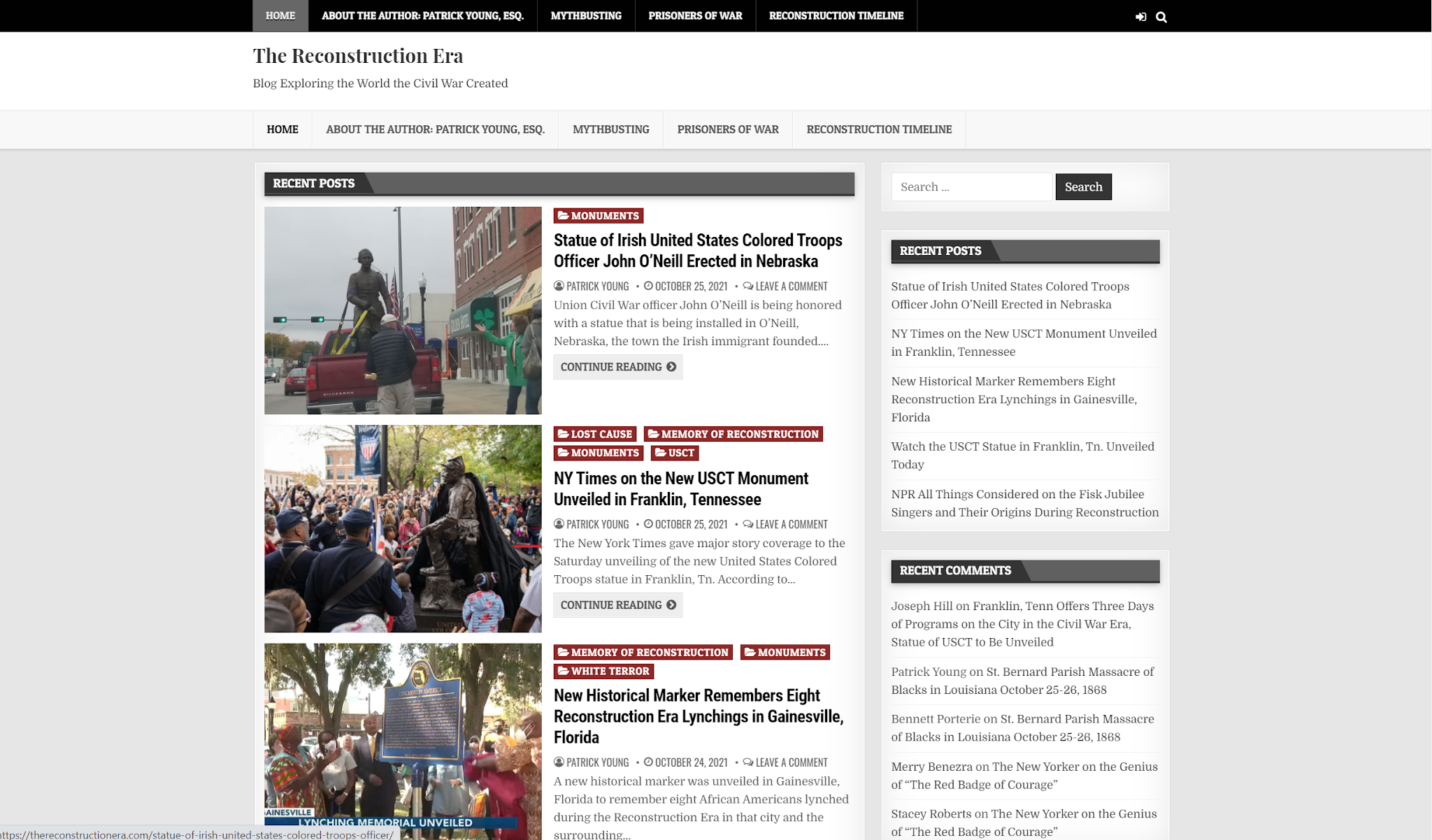


Friday, January 14, 2022

7 Questions With Pat Young, The Reconstruction Era Blog


Pat Young writes The Reconstruction Era Blog and The Immigrants' Civil War. He is Special Professor of Immigration Law at Hofstra Law School in New York and he works to provide services and advocacy for immigrants in New York City, Long Island and the Hudson Valley. ( Reconstruction Era  https://thereconstructionera.com/ , Immigrants' Civil War https://longislandwins.com/immigrants-civil-war/ )


1. How and when did you get  hooked on history?


Like a lot of older white men, I date my interest back to the Civil War Centennial (1961-1965). Since I was only three when the Centennial started, I must have caught the tail end of it. Over time my interest in history matured and I studied the histories of a number of civil wars, and looked at their aftermaths. I was in-country doing human rights research during one civil war, and my wife’s uncle fought in another, the Spanish Civil War, in the “Abraham Lincoln Brigade.” I have interviewed thousands of people who fled civil wars. Most of what I learned told me that the sanitized stories of the American Civil War did not match how people experience the trauma of civil conflict. 


I also learned that the post-war world in countries torn by civil war is not a time of healing. Often the war continues by other means. I thought that further study of the American Civil War and Reconstruction Era might turn up information that was not accounted for in what I learned as a youngster. 


2. What role does history play or has it played in your personal life?


I am a lawyer and all lawyers are involved in the use of history. When we cite precedents, we are using legal history to support our case. Pulitzer Prize-winning historian Jack Rackove calls this “Law Office History,” but it is important for the lawyer to understand the history of a statute to suggest its correct interpretation to the court. 


History has also been important to my life in another way. The immigrants I work with are often the targets of marginalization both because of their race and because of anti-immigrant hatred. Understanding how current concepts of race developed over American history helps me counter implicit bias in modern legislation and law enforcement. Understanding xenophobia from the Know Nothings to modern movements like the Proud Boys helps untangle the arguments of the rhetoricians of hatred. 


3. How does history play  a part in your professional life/career?


My lectures on immigration law at Hofstra University are steeped in the history of the law’s development. In its immigration laws, America wears its heart of darkness on its sleeve. As I tell my students, you can’t understand the Chinese Exclusion Act unless you understand the fevered and deadly hatreds aroused against what was, after all, a very small group of immigrants. 


I recall several years ago being introduced by one of the leaders of Hofstra University’s history department as “a great historian” and being more thrilled by that than by any other introduction I have had in my life. History is important to me. 


4. Why is studying/knowing history important?


Our institutions and laws were developed at specific times in American history. We can’t understand them without knowing the history behind them. If we look, for example, at Alabama’s current constitution we need to  know that its adoption was advocated for by the man most responsible for passing it with these words: “The new Constitution eliminates the ignorant Negro vote and places the control of our government where God Almighty intended it should be — with the Anglo-Saxon race.” Our laws often embed discriminatory intent within legalistic prose. We need to take seriously the invidious discrimination inserted into our laws in the distant past and often still active in the legal system. 


5. What is your favorite period or aspect of history to learn about and why?


The Civil War and Reconstruction eras. This period gave us three enduring Constitutional Amendments; the 13th ending slavery, the 15th eliminating the color line in voting, and the Grand 14th Amendment. That last amendment influences court decisions every day in America. From the citizenship status of children born to immigrants to the right of same-sex couples to marry, the 14th Amendment is a beacon of equality. And it is more than 150 years old!


A lot of people love to study the Revolutionary period, but we are not so concerned today with whether we should be a colony of Britain or not. On the other hand, the issues of 1850 to 1877 are still alive. Racial distinctions, immigration, state v. federal power are all still open questions. 


6.         How did The Reconstruction Era blog get started? 


I already was blogging about immigrants during the Civil War, so I was familiar with the form. I had been posting documents from the Reconstruction Era on a message board and found that they kept getting taken down by the site’s moderators because some people found them controversial. 


I decided that if I was going to invest my limited spare time in researching the period, I needed to have control over whether the materials I developed were displayed. So I started The Reconstruction Era Blog. It quickly gained a following and last year I had more than 85,000 unique visitors from all fifty states and a hundred and fifty countries. 


I am particularly happy to note that the blog has a large following in the South. Five of my Top 10 states in terms of visitation are from the former Confederacy. The notion that Southerners won’t read the unvarnished history of Reconstruction is nonsense. Many of my most loyal readers are from Texas, Virginia, North Carolina, Florida, and Georgia. For them, this is “local history” and they tell me it helps explain the persistent cleavages where they live. 


7. What do you hope readers of The Reconstruction Era blog learn and take away with them?


I hope they gain insight into how we as a country got this way. Racial conflict did not begin in 2020. The Reconstruction Era offers us some frightful examples of the depravity that the doctrine of White Supremacy can lead us to, but it also offers inspiring stories of men and women, black and white, already working towards a world in which progress and diversity are welcome. As Frederick Douglass said in 1867, the “voice of civilization speaks an unmistakable language against the isolation of families, nations and races, and pleads for composite nationality as essential to her triumphs.” We are that “composite nation” formed from many peoples that Douglass dreamed of.


Friday, November 5, 2021

7 Questions with the Tattooed Historian, John Heckman


John Heckman became known to online audiences as The Tattooed Historian in 2015. Since then he has built a digital history network that has a large reach and crosses many subjects within the historical narrative. John earned his graduate degree in 2013 and has worked hard to create a positive legacy in the field of history. When he's not doing history online, you can usually find him drinking a cup of coffee and reading a good book. You can find out more at all of his sites through this link:  https://linktr.ee/TheTattooedHistorian


1)  How did you get hooked on history?

 I became hooked on history around the age of 8 years old. I had a series of emotionally traumatic events in my life from the age of 5 to 8 and I really needed an escape. I found that thing I needed within the pages of history. On top of this, I grew up less than 25 miles from the Gettysburg Battlefield so I would beg my grandparents to take me over there as often as possible to see the sites and try to understand how we envision the past. I found out about historical re-enacting around the age of 12 and I participated in over 500 events throughout the next 25 years or so. 

2) What role does history play or has it played in your personal life?

My personal life has been impacted by history in so many ways. I have gained many friends due to my love of history and in that sense, I have learned how others perceive the historical narrative. It's been a great learning experience to understand things from a psychological/sociological standpoint. History also allowed me to find people in the past who had been through similar situations as myself. Through reading about their personal hurdles, I learned how to navigate some particularly difficult times in my life. 

3) How does history play  a part of your professional life/career?

Professionally, the past has allowed me to build my own digital brand of history for online audiences (The Tattooed Historian). This started out six years ago as a way to find my next job, almost an edgier way of creating a LinkedIn profile. But then it turned into a full-time gig in 2018 and has well over 10,000 followers from many parts of the world. Through this, I have had the chance to meet some amazing historians, students, and others who enjoy talking about history; plugging their books and articles, giving tours, or showcasing exhibits at museums. It has been the greatest networking opportunity for me and is my legacy project. I want to leave something behind that showcases who I am authentically as a historian and citizen. 


4) Why is studying/knowing history important?

Studying the past is so important because, frankly, we all have one. We are all biographies waiting to be written. If we do not realize who we are, the good and the bad, then we are not growing as a people. Think of it this way: we all have our flaws. Perhaps we want to lose weight or gain muscle. To do that, we have to work out, eat better, etc. It's okay to have the desire to want to be better than we were. We must embrace the primary sources, focus on their message in a lateral sense (not linear), and realize that we can create positive changes from understanding the lessons of the past. To run from the past is one way to negatively impact our future. 

5) What is your favorite period or aspect of history to learn about and why?

I love to learn about a variety of things. You can find me reading about the history of death and burials, food, body modification, disasters, and conflict. I enjoy learning about all things history as long as it is backed up by primary resources and peer-reviewed analysis. I'm not into reading the "What Ifs" of history though. What actually happened is interesting in itself! 


6) How did you become the Tattooed Historian?

I became "The Tattooed Historian" by embracing who I am, instead of wishing to fit into what was traditionally being tossed around as "what a historian looks like." I was tattooed before I earned any of my degrees in history so this wasn't a way for me to bring some sort of fake shock value to my brand. I had actually been denied a job in the field due to having tattoos below my elbows. I set out to prove that you can be tattooed and good at what you do; my tattoos are not my resume. I've also created a very welcoming place for all of those who love history no matter their race, religion, sexual orientation, or gender identity. I've been judged based on my tattoos and I will not allow others to be judged based on who they are; ignorance and hate have no home on my pages and is banned immediately. What you see is what you get with me. I'm the same in person as I am on a livestream and I think that authenticity has helped my brand grow exponentially.


7)  What can followers of the Tattooed Historian expect from your social media?

The content on The Tattooed Historian pages is a wide variety of things. I do a lot of livestream events including many with authors and others who wish to plug their work. I play historically-based games on Twitch and YouTube from time to time. We have times where I just chat with followers to get their input and feedback about things in the history field. The Tattooed Historian Show is my podcast which just started up again for another season and can include audio from previous livestreams as well as newer content. And the historical subjects are all over the place from World War I to Charlie Brown to George Washington's cabinet when he was president. There's something for everyone!